


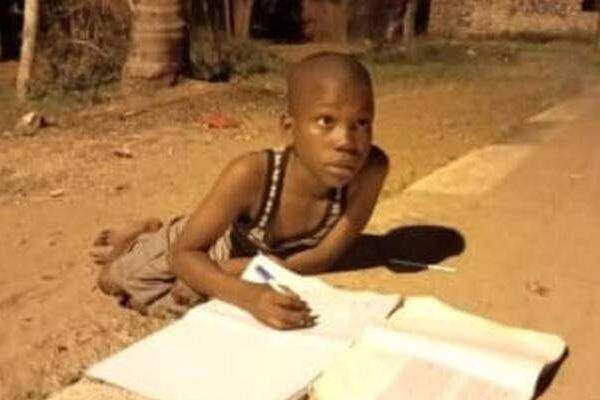
In a world where basic necessities like electricity seem so commonplace, a boy was found studying under the harsh glare of a solar streetlight by the roadside pierces the conscience.
This boy, a silent symbol of resilience, refuses to let his family’s lack of electricity dim his dreams.
His story, unfolding late into the night, raises urgent questions about the government’s failure to provide basic amenities for education and the inequalities that persist in our communities.
A Light Amid Darkness: The Unseen Struggles
Abraham Akanyene, a 14-year-old junior secondary school student in Uruan Local Government Area, has become an unwilling icon of hardship and determination.
Without electricity at home, he took to the streets, using the weak but steady glow of a solar streetlight to pour over his books.
His nightly routine, witnessed by passersby and caught on camera, reveals a cruel irony.
The public infrastructure that should illuminate entire neighborhoods shines most brightly on a child’s hopes and dreams.
Living in darkness at home is not just inconvenient, it’s a barrier to education that few outside his community understand.
Yet, Abraham studies diligently, the streetlight his only tutor in the silence of night.
His situation shines a painful spotlight on systemic neglect where children are forced to study in the most adverse conditions.
Government Neglect in the Era of Progress
Why does Nigeria, with its vast resources and growing economy, still have children studying under streetlights?
This is the gnawing question that Abraham’s story forces us to confront.
It is not just an isolated tale but a reflection of broader governmental failure.
Promises of rural electrification and educational investment sound hollow when students like Abraham fend for themselves.
The state of infrastructure remains woefully inadequate.
Roads may be paved, but homes still lack power, and schools struggle without essential electricity.
This neglect fuels inequality, trapping children in a cycle of poverty that far too few can escape.
Inspiring Yet Infuriating: The Duality of Abraham’s Story
Emotionally, Abraham’s resilience inspires hope, it is a testament to human spirit and determination.
Yet, it stirs indignation.
How long must children bear the burden of governmental inertia?
The public’s outcry following the viral incident of Abraham studying by streetlight has been loud, and rightly so.
Critics argue this kind of viral exposure, while noble, cannot substitute direct intervention.
Many wonder why it takes viral social media posts to spotlight issues that have persisted for decades.
Abraham’s story is a powerful call to action, a plea that the authorities cannot continue to ignore.
Community Solidarity and the Power of Hope
The reaction from local communities and well-wishers has been swift and heartwarming.
Such gestures, while appreciated, underscore that every Nigerian child deserves guaranteed electricity and quality education.
These grassroots responses also mirror similar incidents elsewhere.
In Kenya, a young boy named Salim Khamis went viral for studying under streetlights.
His story too led to donations of solar systems that transformed his nightly study conditions.
These shared stories speak to a global challenge but also highlight the power of collective goodwill in addressing immediate needs.
An Urgent Call for Policy Change
Abraham’s story is not just an emotive viral post, it demands structural change.
It calls for accountability from local and federal governments to fulfill their responsibilities.
Immediate steps must include enhancing rural electrification programs, prioritizing education funding, and ensuring all children have safe, well-lit environments for study.
This story, while inspiring, should not be a celebration of survival against the odds but a catalyst for systemic reform.
Governments must shift focus from fleeting media scandals to long-term solutions that guarantee no child studies under streetlights anymore.
