


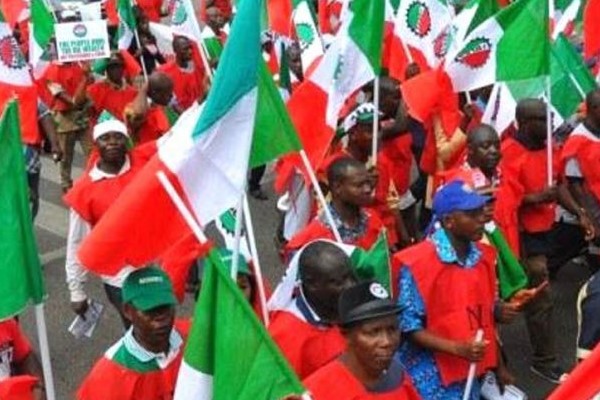
Members of the Nigeria Labour Congress (NLC) launched widespread protests across Lagos on Wednesday, December 17, 2025, undeterred by a late-night meeting with President Bola Tinubu at Aso Rock the previous evening, signaling deep frustration with the federal government’s handling of escalating insecurity nationwide.
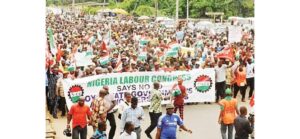
According to report, a large crowd of workers, union leaders, and civil society allies converged on major streets, chanting slogans and displaying placards that decried rampant kidnappings, armed robberies, and banditry plaguing urban centers and rural communities alike.
The demonstration, marked by orderly marches from union secretariats to symbolic government landmarks like the Lagos State House of Assembly.
NLC Demands: Police Boost, Intel Reform, Community Security
This underscored the NLC’s resolve to pressure authorities into deploying decisive measures, including enhanced policing, intelligence reforms, and community security initiatives.
Despite the high-level dialogue with Tinubu, where labor representatives reportedly presented a 10-point security roadmap.
The absence of immediate commitments prompted organizers to proceed, framing the action as a necessary escalation in their campaign for citizen safety.
This development highlights a growing rift between organized labor and the executive.
With the NLC positioning itself as the vanguard of public discontent amid economic hardships compounded by pervasive threats to life and livelihood.
The protests erupted amid a spike in violent incidents that have gripped Nigeria over recent weeks.
From high-profile abductions in Kaduna and Zamfara to brazen daylight attacks in Lagos suburbs like Ikorodu and Agege.
NLC President Joe Ajaero, addressing demonstrators at the Yaba rally point, lambasted the administration’s security architecture as “reactive and inadequate,” vowing sustained advocacy until tangible results emerge.
NLC Placards Scream: “Tinubu Resign or Secure Us”
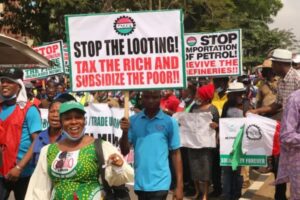
Placards bore messages like “End Bloodshed Now,” “Tinubu: Secure Nigeria or Resign,” and “Workers Demand Safety.”
Reflecting broad-based anger from daily wage earners vulnerable to crime during commutes and market activities.
Eyewitnesses reported heavy police presence, with officers maintaining a cordon to prevent disruptions to traffic.
Though tensions simmered as protesters clashed verbally with security personnel over road blockages.
The Lagos State Police Command issued a statement pre-emptively assuring protection for peaceful assemblies while warning against violence.
A nod to past NLC actions that occasionally escalated into skirmishes.
This mobilization follows similar unrest in Abuja and Port Harcourt, where labor chapters amplified calls for state governors to complement federal efforts with local vigilante integrations and youth empowerment programs to deter crime.
Roots of Labor’s Security Frustration
A pattern rooted in unfulfilled promises from prior engagements on minimum wage hikes and fuel subsidy palliatives.
Sources close to the meeting disclosed that Tinubu listened attentively to labor’s grievances, pledging inter-agency coordination under the National Security Adviser.
But stopped short of timelines or funding allocations that unions demanded.
Ajaero later clarified in a press briefing that while “frank exchanges occurred,” the President’s assurances lacked the urgency matching citizens’ peril, justifying the protests as “pre-emptive accountability.”
This stance aligns with NLC’s constitutional mandate to safeguard workers’ welfare.
Extending beyond wages to existential threats like insecurity that erode productivity and inflate living costs through protection rackets.
Insecurity Drains Nigeria’s GDP 5-7% Yearly
Economists estimate insecurity drains Nigeria’s GDP by 5-7% annually via disrupted agriculture, commerce halts, and capital flight, figures labor leaders wielded to underscore their case.
The Lagos protests, drawing thousands from transport unions, market associations, and informal sectors, amplified this economic-security nexus.
With participants sharing harrowing tales of lost relatives and shuttered businesses, humanizing statistics into a clarion call for systemic overhaul.
Tinubu’s administration, since inauguration in 2023, has rolled out initiatives like Operation Safe Haven expansions and digital surveillance platforms.
Yet metrics from the National Bureau of Statistics show homicide rates climbing 15% year-on-year, fueling skepticism.
Labor’s roadmap, leaked post-meeting, advocates forensic audits of security votes.
Mandatory asset declarations for service chiefs, and community policing mandates devolved to local governments.
Critics within APC circles decry NLC’s tactics as politically motivated ahead of 2027.
Potentially undermining investor confidence, but supporters hail it as democratic pressure valve.
Historical precedents, including 2018 ASUU strikes and 2022 EndSARS synergies.
Bolster NLC’s leverage, where street power has extracted concessions like electoral act amendments.
Wednesday’s events saw solidarity from student unions and trader guilds.
Broadening the coalition and pressuring Lagos Governor Babajide Sanwo-Olu to convene emergency town halls, illustrating ripple effects on state-federal dynamics.
Government Response and Broader Implications
Federal spokespersons, including Information Minister Mohammed Idris, characterized the meeting as “constructive.”
Hinting at forthcoming executive orders on border fortifications and youth recruitment into civil defense.
However, NLC dismissed such previews as “rhetoric recycling,” committing to nationwide shutdowns if protests yield no arrests of high-profile bandits within 72 hours.
Security analysts predict short-term deployments of mobile police squads to hotspots.
But warn sustainable gains require judicial swiftness on prosecutions, over 90% of cases currently languish per Amnesty International data.
The protests’ choreography, with designated routes and megaphone amplifications, minimized chaos.
Earning cautious praise from rights groups monitoring for excessive force.
In Lagos, economic epicenter contributing 30% of national GDP, insecurity manifests as surging premiums for private guards and insurance hikes, squeezing SMEs that form NLC’s backbone.
Protesters halted briefly at Alausa Secretariat, submitting a petition outlining 30-day remediation benchmarks, from intelligence-sharing protocols to victim compensation funds.
This tactical pivot from disruption to documentation signals maturing protest strategies, pressuring bureaucrats via paper trails amenable to judicial review.
Internationally, the events draw scrutiny from ILO affiliates, potentially influencing Nigeria’s labor ratings and aid packages tied to human security indicators.
Path Forward Amid Escalating Tensions
Political observers foresee mediated talks via National Peace Committee, blending concessions like wage adjustments with security metrics.
Tinubu’s balancing act, courting FDI while assuaging domestic fury, tests his reformist credentials, where insecurity overshadows subsidy wins.
Labor’s defiance post-meeting recalibrates power equations, reminding governance of accountability’s street face.
Success hinges on bridging rhetoric-reality gaps, lest protests evolve into broader anti-government waves.
Long-term, NLC’s campaign spotlights interconnected crises.
Unemployment fueling crime, corruption siphoning security budgets.
Policy wonks advocate holistic approaches, skills academies in volatile zones, agro-allied policing, tech-driven early warnings.
Tinubu’s legacy pivots on taming this hydra, validating 2023 mandates.
As workers returned homes navigating dusk perils, optimism flickered amid resolve: protests as catalyst, not chaos.
