


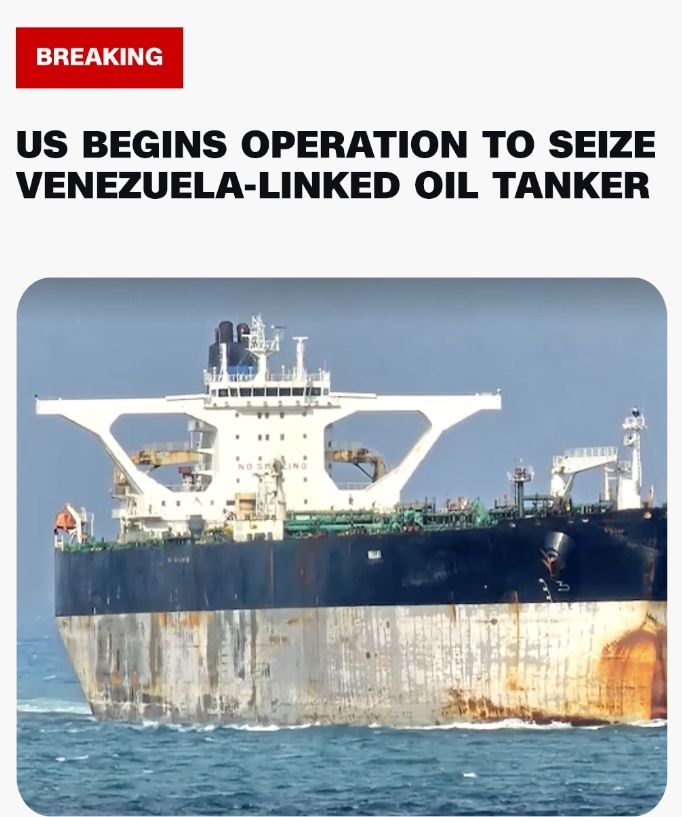
The global energy and security order was jolted today after the United States seized a Russian flagged oil tanker in international waters, an action Moscow has denounced as illegal, provocative, and tantamount to piracy.
The incident, involving the vessel Marinera (formerly Bella 1), marks a sharp escalation in Washington’s campaign to choke Venezuelan oil exports and underscores President Donald Trump’s renewed hard-line approach to sanctions enforcement.
This is not a routine maritime interception. It is a calculated assertion of power and the world is taking note.
THE SEIZURE: WHAT HAPPENED AND WHERE
According to U.S. officials, the Marinera was boarded and seized by U.S. Coast Guard and military personnel in the North Atlantic near Iceland after a weeks long pursuit.
The tanker, flying a Russian flag, was allegedly transporting Venezuelan crude oil in defiance of U.S. sanctions.
The ship had previously evaded U.S. monitoring and slipped through maritime pressure zones in the Caribbean, reinforcing Washington’s belief that it was part of a wider “shadow fleet” facilitating sanctioned oil trade.
U.S. authorities described the operation as a lawful enforcement action carried out under existing sanctions frameworks and court authorisations.
Two American officials confirmed there was no direct confrontation with Russian naval assets, though Russian military vessels , including a submarine , were reported to be operating in the general vicinity.
RUSSIA’S RESPONSE: “OUTRIGHT PIRACY”
Moscow reacted swiftly and sharply.
Russia’s Transport Ministry said contact with the Marinera was lost following the U.S. boarding and accused Washington of violating international maritime law.
Citing the 1982 United Nations Convention on the Law of the Sea, Russia insisted that freedom of navigation on the high seas prohibits the use of force against a vessel lawfully registered under another nation’s flag.
A senior Russian lawmaker, Andrei Klishas, went further, calling the action “outright piracy” and accusing the United States of abandoning international norms under the guise of law enforcement.
Russia’s Foreign Ministry demanded that the U.S. guarantee humane treatment of the tanker’s crew and ensure their immediate return home.
As of this report, the Kremlin has not issued a direct statement, though diplomatic channels buzz with activity.
THE VENEZUELA CONNECTION: SANCTIONS WITH TEETH
The seizure is directly linked to Washington’s intensified pressure campaign against Venezuela.
In recent days, the Trump administration dramatically escalated its posture.
On January 3, it captured Venezuelan leader Nicolás Maduro in an operation and flew him to New York to face long-standing drug trafficking charges.
The tanker seizure forms part of the same strategic arc cutting off Venezuela’s economic lifelines and dismantling external support networks.
With Maduro removed and an interim government sworn in, the U.S. is now moving to ensure that sanctioned Venezuelan crude does not continue flowing through covert channels, particularly with assistance from Russian linked entities.
For Moscow, this represents not only a legal dispute but a geopolitical setback.
Venezuela had been one of Russia’s last major strategic allies outside its immediate sphere, following the fall of Syria’s Bashar al Assad in late 2024.
WHY THIS MATTERS: GLOBAL OIL MARKET IMPLICATIONS
The implications extend far beyond diplomacy.
Increased Market Volatility
The seizure signals that the U.S. will physically interdict oil shipments, not just sanction them on paper.
Traders are now reassessing risk premiums for shipments linked to sanctioned states, which could tighten supply routes and push prices upward in the short term.
Pressure on “Shadow Fleets”
Dozens of tankers operating under opaque ownership structures may now reconsider routes, insurance, and flag registrations.
This could disrupt informal supply chains feeding Asia, Africa, and parts of Latin America.
Insurance and Shipping Costs
Maritime insurers are likely to raise premiums for vessels operating near sanctions enforcement zones, increasing transport costs and indirectly impacting fuel prices worldwide.
Geopolitical Risk Premium Returns
After years of relative adaptation to sanctions, energy markets may once again price in geopolitical confrontation, particularly if Russia responds with reciprocal actions or legal challenges in international forums.
A BROADER SIGNAL FROM WASHINGTON
This posture carries risk.
Military incidents between nuclear-armed powers remain rare, but history shows that miscalculation at sea can spiral quickly.
Yet from Washington’s perspective, restraint has failed. Sanctions without enforcement, the argument goes, invite circumvention.
WHAT COMES NEXT
All eyes are now on three fronts:
Diplomacy: Whether Russia pursues formal international arbitration or escalates rhetorically and militarily.
Energy Markets: How traders, insurers, and shipping firms recalibrate exposure.
Global Precedent:
Whether other nations follow Washington’s lead or push back against what Moscow calls a dangerous erosion of maritime norms.
This is not just about one tanker. It is about who controls the arteries of global trade in an era where oil, power, and law collide.
The sea has always been a proving ground for empires. Today, it speaks again.
