


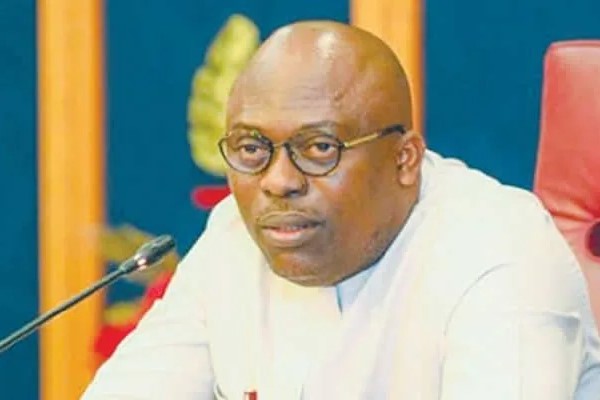
Rivers State is once again standing on the frontline of Nigerian politics with the latest impeachment notice against Governor Siminalayi Fubara which has reignited a familiar storm, one that blends law, power, and old political rivalries into a combustible mix.
This is not just another legislative dispute rather, It is a defining moment in the Rivers impeachment saga, exposing unresolved tensions within the political elite and testing the resilience of democratic institutions in one of Nigeria’s most strategic states.
A sharp counter raised in the midst of the controversy are eight serious allegations by the Rivers State House of Assembly,
Response from the All Progressives Congress (APC), which has outrightly rejected the impeachment move, warning that it threatens governance stability and political order.
What the Assembly Is Claiming
The Rivers State House of Assembly has anchored its impeachment notice on the following accusations.
Reckless and unconstitutional expenditure of public funds without legislative approval.
Misappropriation of public funds, allegedly outside approved budgetary frameworks.
Deliberate obstruction of the House of Assembly, preventing lawmakers from performing their constitutional duties.
Illegal appointments, carried out without mandatory legislative screening and confirmation.
Seizure of salaries and allowances meant for members of the House of Assembly.
Withholding of the salary of the Clerk of the House, Mr. Emeka Amadi.
Refusal to implement constitutional provisions on financial autonomy for the legislature and judiciary.
Withholding of funds for the Rivers State House of Assembly Service Commission, crippling its statutory operations.
Taken individually, each allegation raises constitutional red flags.
Taken collectively, they present a narrative of executive dominance and institutional suffocation ,one the Assembly argues justifies impeachment.
This has pushed the Rivers State House of Assembly crisis into national focus.
APC Responds : “This Is Not Governance, This Is Politicking”
In a strongly worded statement dated January 8, 2026, the Rivers State chapter of the APC rejected the impeachment process in its entirety.
While acknowledging the constitutional independence of the legislature, the party argued that the move reeks of political vendetta rather than accountability.
Describing it as a continuation of unresolved internal conflicts, particularly fallout from past PDP crises now resurfacing under APC governance.
The APC’s position rests on three strategic pillars:
Budgetary Context Cannot Be Ignored
- According to the APC, during the period of emergency governance, a ₦1.485 trillion budget was lawfully transmitted to and approved by the National Assembly in mid-2025.
- The APC further argued that Nigerian constitutional practice permits governors to operate within a six-month spending window into a new fiscal year.
- This has weakening claims that Governor Fubara violated budgetary procedures.
- This, they say, fundamentally undercuts the impeachment narrative.
Impeachment Equals Destabilization
- Most critically, the APC warned its lawmakers, especially those within its own ranks, against yielding to external political pressure aimed at destabilizing an APC-led government.
- The party described the impeachment attempt as fratricidal, cautioning that power struggles masked as constitutionalism often leave states worse off.
- This position has reinforced headlines around “APC rejects Fubara impeachment.”
The Bigger Picture: Law, Power, and Political Leverage
Stripped of rhetoric, the Rivers political crisis 2026 reveals a deeper, uncomfortable truth: impeachment in Nigeria has increasingly become a political weapon rather than a last-resort constitutional safeguard.
While allegations of misconduct must always be taken seriously, timing, motive, and proportionality matter. The APC’s intervention reframes the saga as a struggle between governance continuity and political brinkmanship.
What Happens Next?
Key Implications to Watch:
- Governance Risk: Prolonged impeachment proceedings could stall development projects and erode investor confidence.
- Party Integrity: The APC faces an internal stress test ,can it manage power without imploding from within?
- Constitutional Precedent: How financial autonomy and legislative oversight are interpreted here could set a national benchmark.
Democracy or Politicocracy?
As the APC bluntly warned, Rivers State now stands at a crossroads democracy or politicocracy.
This impeachment saga is no longer solely about Governor Siminalayi Fubara.
It is about whether political actors can subordinate personal battles to institutional stability.
A nd whether constitutional tools will be used to strengthen governance or sabotage it.
History is unforgiving. States move forward when leaders argue within the law, not when they weaponize it.
The coming days will determine whether Rivers State has learned from its past, or is once again condemned to repeat it.

1 Comment
Pingback: ‘Wike-Fubara Enmity Fuels Rivers Crisis’ – Lawyer Effiong - wahalaupdate