


In a significant development for regional security, the Nigerian Army announced the voluntary surrender of over 80 Niger Delta militants in Cross River State’s Akpabuyo Local Government Area.
This event, occurring under the Cross River State Government’s amnesty programme, marks a pivotal step toward de-escalating militancy in the oil-rich Niger Delta region.
The militants, emerging from hideouts in the early hours of January 16, 2026, laid down their weapons at the Atimbo Rear Area of Operation OKWOK, signaling a willingness to embrace peace and reintegration.
Headquarters 13 Brigade of the Nigerian Army released an official statement on Friday detailing the surrender.
Signed by Major Yemi Sokoya, Assistant Director of Army Public Relations, the release emphasized the collaborative efforts between military forces, state authorities, and security agencies.
This initiative aligns with broader national strategies to curb oil theft, pipeline vandalism, and maritime piracy.
Persistent threats that have plagued the Niger Delta for decades, costing Nigeria billions in lost revenue annually.
The surrender underscores the effectiveness of sustained kinetic and non-kinetic operations.
By combining rigorous patrols with amnesty incentives, authorities have created pathways for former combatants to transition into civilian life.
This event not only bolsters confidence in government programmes but also sets a precedent for similar groups in neighboring states like Delta, Bayelsa, and Rivers.
Details of the Surrendering Groups and Arms Cache
The militants hailed from two distinct camps, each led by notorious figures with histories of maritime raids and illegal bunkering.
The first group, commanded by ThankGod Ebikontei, better known as Ayibanuagha, comprised 39 fighters.
Ebikontei, whose alias translates to “the world is wicked” in local pidgin, had evaded capture for years while orchestrating attacks on vessels in the Calabar River waterways.
The second, larger faction of 41 members operated under John Isaac, alias Akpokolo, leader of the Akpokolo Marine Forces, also dubbed the Border Boys.
This group specialized in cross-border smuggling and ambushes near the Cameroon-Nigeria maritime boundary, exacerbating tensions in the Gulf of Guinea.
Their surrender represents a critical blow to organized crime syndicates exploiting the region’s porous waters.
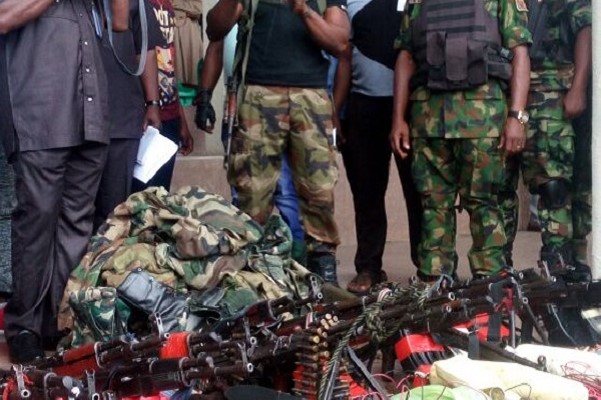
During the meticulously documented handover, the militants relinquished an impressive arsenal.
Key items included three AK-47 rifles, two pump-action shotguns, one Mark 4 rifle, and one G3 rifle, platforms favored for their reliability in humid, riverine environments.
They surrendered 12 dane guns, 10 AK-47 magazines, three boat engines, C4 explosive, 19 NATO rounds, 84 cartridges.
Additional recoveries comprised assorted military camouflage kits, welding tools for boat repairs, crude explosive devices, and other accessories indicative of a well-equipped operation.
Forensic analysis of these items, now in military custody, will likely reveal links to international arms smuggling networks.
This haul alone could disrupt dozens of potential raids, protecting commercial shipping lanes vital to Nigeria’s economy.
The process unfolded without incident, with Army personnel providing security while state officials facilitated profiling.
Army-released videos show militants in tattered gear stacking weapons under watch, symbolizing full capitulation.
Brigadier General Alimikhena’s Assessment and Strategic Implications
He credited success to sustained operations, engagement, and collaboration with Cross River Government and security agencies.
Alimikhena stressed that such integrated approaches restore peace more enduringly than force alone.
“These former militants clearly demonstrate that our multi-pronged strategy works,” he added.
13 Brigade intensified Operation OKWOK patrols since 2024, achieving 200 arrests, 150 weapons seizures in southeast creeks.
This surrender amplifies those gains, potentially freeing resources for anti-banditry efforts in the North.
Experts view this as part of a larger deradicalization wave.
Since the 2009 Amnesty Programme under late President Umaru Yar’Adua, over 30,000 ex-militants have disarmed nationwide.
Cross River’s iteration, revived by Governor Bassey Edet Otu in 2025, offers vocational training, stipends, and scholarships, tailored to youths radicalized by poverty and unemployment.
Data from the Presidential Amnesty Office shows reintegrated fighters enjoy 75% employment rates post-programme, reducing recidivism.
However, challenges persist. Analysts warn of splinter groups and economic drivers like illegal refining, which generates $2 billion illicitly yearly.
Sustained investment in alternatives, such as the $1.5 billion modular refineries in Akwa Ibom, is crucial to prevent relapse.
Handover, Profiling, and Path to Reintegration
Post-surrender, the militants underwent formal handover to the Cross River State Government’s Rapid Response Team.
They now reside at Muka Sam Hotel in Ikot Ansa, Calabar, for profiling by the Department of State Services (DSS).
This phase involves biometric verification, background checks, and psychological assessments to weed out infiltrators and ensure genuine commitment.
Otu’s “Peace Pact Initiative,” launched amid 2025 floods displacing 50,000, has disbursed N500 million in amnesty funds, funding skills in welding, fishing, and agriculture.
Looking ahead, the Nigerian Army recommitted to “consolidating gains and preventing relapse into criminality.”
Public appeals urge citizens to provide actionable intelligence via hotlines, fostering community ownership of security.
This event reverberates beyond Cross River, inspiring similar surrenders in Bayelsa where 25 militants yielded last month.
Nigeria’s multi-front insecurity, from Boko Haram to banditry, shows amnesty complements force, reviving Delta economy.
In total, this breakthrough not only disarms immediate threats but signals hope for a stable Niger Delta, where peace could unlock untapped oil and gas potentials worth trillions.
As Alimikhena noted, “Lasting stability demands vigilance, partnership, and opportunity.” With 80 fewer fighters at large, Cross River breathes easier today.
