


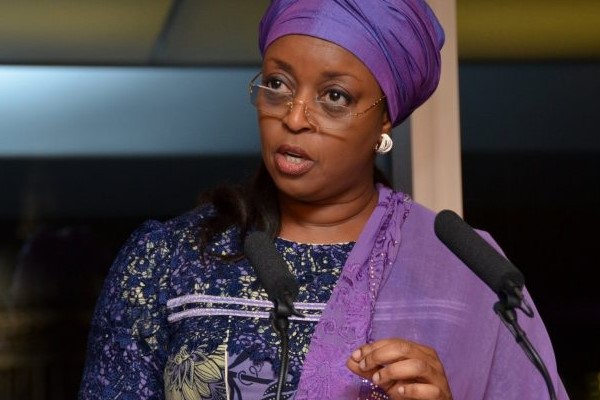
Diezani Alison-Madueke, Nigeria’s former Minister of Petroleum Resources, made her first court appearance on Monday at Southwark Crown Court in London for the preliminary hearing of her high-profile bribery trial.
The session, presided over by Justice Thornton in Court 8, sets the stage for the full trial slated to begin on January 26, 2026.
This development marks a pivotal moment in a legal saga that has spanned nearly three years, captivating observers in Nigeria.
The UK, and beyond due to its intersections with global corruption probes, asset forfeiture, and Nigeria’s oil sector governance.
Diezani Alison-Madueke, once a towering figure in Nigeria’s energy landscape, faces serious allegations that could reshape perceptions of accountability in public office.
Charged by UK authorities in August 2023, she is accused of accepting a £100,000 bribe in exchange for influencing the award of lucrative oil and gas contracts.
The UK’s National Crime Agency (NCA) alleges that during her tenure from 2010 to 2015 under President Goodluck Jonathan’s administration.
She solicited and received illicit payments to favor specific contractors.
These claims strike at the heart of Nigeria’s petroleum industry, which accounts for over 90% of the country’s export earnings and has long been a hotspot for graft allegations.
A Storied Career Marred by Scandal
Diezani Madueke’s rise to prominence was meteoric.
Appointed Petroleum Minister in April 2010, she oversaw the Nigerian National Petroleum Corporation (NNPC) during a period of unprecedented oil price booms, which fueled Nigeria’s economy but also amplified opportunities for mismanagement.
Her portfolio extended to international diplomacy.
In 2014, she achieved a historic milestone by becoming the first woman elected President of the Organisation of Petroleum Exporting Countries (OPEC).
This role positioned her as a global advocate for oil-producing nations, yet it also drew scrutiny amid whispers of opacity in contract awards.
Her tenure coincided with explosive growth in Nigeria’s oil sector. Between 2010 and 2015.
The country awarded contracts worth billions, including deepwater exploration deals and refinery upgrades.
Critics, including civil society groups like Transparency International, pointed to irregularities.
Opaque bidding processes, inflated costs, and favoritism toward politically connected firms.
Diezani Madueke’s defenders argued she navigated a challenging landscape of militancy in the Niger Delta and global market volatility.
But post-tenure investigations painted a darker picture.
She resigned in 2015 amid the Jonathan administration’s electoral defeat and fled to the UK, where she has resided under legal constraints ever since.
The Charges and Bail Conditions
The NCA’s case centers on a specific instance of bribery tied to oil contracts valued at multi-millions of pounds.
Prosecutors claim Alison-Madueke leveraged her authority to grant undue advantages, receiving kickbacks that violated UK anti-corruption laws, including the Bribery Act 2010.
While the charges specify £100,000, they form part of a broader narrative of systemic corruption unearthed through international cooperation.
Following her initial arrest in October 2023, Alison-Madueke appeared before Westminster Magistrates’ Court, where she was granted bail for £70,000.
The court labeled her a flight risk, citing her international profile and access to resources. stringent conditions were imposed.
A nightly curfew from 11 pm to 6 am, continuous wear of an electronic monitoring tag, and a £70,000 surety.
These measures underscore the gravity with which UK authorities view the case.
Reflecting a zero-tolerance stance on foreign corruption proceeds laundered through London’s financial hubs.
The preliminary hearing at Southwark Crown Court was procedural, focusing on scheduling, evidence disclosure, and trial logistics.
Justice Thornton confirmed the January 26 start date, allowing limited time for final preparations.
Legal experts anticipate a trial lasting several weeks, with witness testimonies from NCA investigators, former Nigerian officials, and possibly oil executives.
Diezani represented by a top-tier defense team, has denied all wrongdoing, maintaining that the allegations are politically motivated.
Entangled in Global Asset Recovery Efforts
Beyond the UK criminal proceedings, Alison-Madueke faces a web of asset recovery actions spanning jurisdictions.
These cases highlight the multinational scope of her alleged schemes and Nigeria’s push for repatriation under President Bola Tinubu’s anti-corruption drive.
In January 2025, Nigeria and the United States formalized an agreement to return $52.88 million linked to “Galactica” assets.
US prosecutors from the Department of Justice alleged that proceeds from rigged oil contracts funded extravagant purchases.
Luxury penthouses in California and New York, plus the 65-meter superyacht Galactica Star.
Valued at over $100 million, the yacht became a symbol of excess, seized in 2016 off Equatorial Guinea.
The funds’ return, facilitated by mutual legal assistance treaties, bolsters Nigeria’s coffers amid economic pressures from oil theft and subsidy reforms.
Domestically, Nigeria’s Economic and Financial Crimes Commission (EFCC) has aggressively pursued leads.
High-profile seizures include a $153 million Malabu oil block scandal tied to her era.
Properties in Abuja and Lagos, and bank accounts frozen under interim orders.
Alison-Madueke’s cases exemplify how kleptocrats exploit offshore havens, prompting reforms like the Proceeds of Crime Bill in Nigeria.
Broader Implications for Nigeria and International Justice
This trial reverberates far beyond the courtroom.
For Nigeria, it tests the resilience of its anti-corruption architecture.
This has since implemented e-bidding platforms and transparency audits.
Yet, scandals persist, with recent probes into fuel subsidy fraud echoing past vulnerabilities.
Internationally, the case reinforces the UK’s role as a hub for pursuing “dirty money.”
Post-Brexit, London has intensified enforcement via the Economic Crime and Corporate Transparency Act 2023, targeting enablers like lawyers and realtors.
It also strengthens US-Nigeria ties, evident in joint task forces like the Kleptocapture Center.
Public reaction in Nigeria remains polarized.
Supporters view Diezani as a scapegoat in gender-biased politics, Africa’s first female OPEC head scapegoated amid male-dominated graft probes.
Detractors, including activists from BudgIT and #EndSARS coalitions, demand full accountability, arguing her impunity eroded public trust.
Social media buzz, amplified on platforms like X (formerly Twitter), frames the trial as a litmus test for Tinubu’s “Renewed Hope” agenda.
As the full trial approaches, stakeholders watch closely.
A conviction could lead to imprisonment and further forfeitures; acquittal might embolden critics of selective justice.
Either way, Diezani Alison-Madueke’s legacy, trailblazer or emblem of avarice, hangs in the balance, a cautionary tale for resource-rich nations grappling with the corruption curse.
