


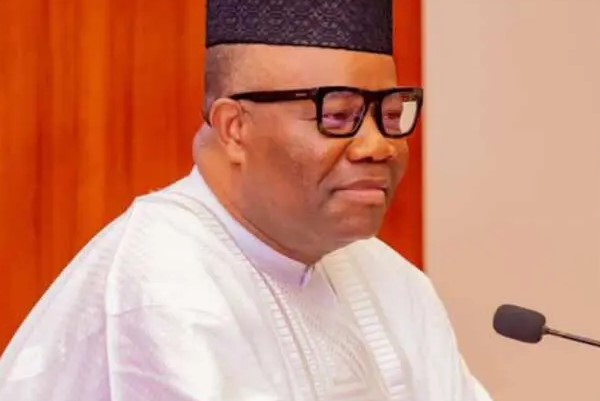
Senate President Godswill Akpabio is reportedly receiving urgent medical treatment in London, United Kingdom, after collapsing earlier this month.
According to sources within the National Assembly cited by SaharaReporters.
The development has sparked widespread speculation about his health and leadership capacity.
Particularly as he missed critical legislative engagements, including the Medium Term Expenditure Framework (MTEF) and Fiscal Strategy Paper (FSP) interactive session.
Akpabio, a key figure in Nigeria’s 10th National Assembly, was transported via a private jet reportedly provided by billionaire industrialist Aliko Dangote.
Highlighting the gravity of his condition and the involvement of prominent private sector players in national political health crises.
This incident marks the second time Akpabio has been rushed to London for treatment.
Fueling debates on the adequacy of domestic healthcare infrastructure for high-ranking officials and raising questions about transparency in public office health disclosures.
The collapse occurred on December 10, prompting immediate evacuation abroad, where Akpabio remains under close medical supervision.
National Assembly insiders revealed that his absence extended to the pivotal MTEF/FSP flag-off event on Wednesday.
A cornerstone session for outlining Nigeria’s fiscal roadmap through 2027.
Senator Onyekachi Nwaebonyi stepped in as his representative, underscoring the procedural adaptations necessitated by the Senate President’s unavailability.
Sources emphasized the procedural weight of the session, where budgetary frameworks are scrutinized.
And Akpabio’s no-show amplified perceptions of institutional vulnerability at a time when economic reforms under President Bola Tinubu demand robust legislative oversight.
The episode has ignited discussions on succession protocols within the Senate.
With whispers of contingency plans circulating among principal officers.
Though no official statements have emanated from the National Assembly leadership.
Medical Advice and Senatorial Concern Escalate Speculation
Reports indicate Akpabio’s condition is severe, with attending physicians in London advising him to step down from his Senate presidency to prioritize recovery.
This recommendation, relayed through confidential medical briefings to SaharaReporters.
Has prompted several senators to travel to the UK to visit him, signaling deep concern within the upper chamber.
One source poignantly noted, “A number of senators have gone to visit him,” reflecting the personal and political bonds at stake.
Akpabio’s last public appearance was on December 9, during the Senate’s approval of President Tinubu’s request to deploy troops to the Republic of Benin.
A decision that underscored his active role in foreign policy matters just days before his health crisis unfolded.
The timing of this collapse, amid escalating national debates on security, economy, and constitutional amendments, has left a leadership vacuum that acting deputies are scrambling to fill.
Prompting analysts to question the resilience of Nigeria’s legislative architecture.
Akpabio’s repeated medical evacuations to London, this being the second instance, expose systemic flaws in Nigeria’s healthcare system.
Where elite politicians bypass local facilities for overseas care.
Critics argue this practice drains national resources through private jets and foreign expenditures while ordinary citizens grapple with dilapidated public hospitals.
Dangote’s reported involvement in providing the jet adds a layer of intrigue, illustrating the intertwining of business oligarchs and political power structures.
Political observers note that Senate President Akpabio, a former Akwa Ibom governor and APC stalwart, has been a linchpin in Tinubu’s legislative agenda.
Pushing through bills on tax reforms, power sector privatization, and student loans.
His potential exit could disrupt this synergy, emboldening opposition forces like the PDP to challenge APC dominance in the Senate, where the ruling party holds a slim majority.
Implications for National Assembly Leadership and Governance
The Senate President’s hospitalization arrives at a precarious juncture for Nigeria’s polity.
With the 2026 budget preparations looming and constitutional reviews underway.
Akpabio’s absence from the MTEF/FSP session, described by sources as a “missed critical presentation,” could delay fiscal approvals essential for infrastructure funding and debt management strategies.
Deputy Senate President Akpabio Jibrin Barau has assumed interim duties.
But protocol dictates that prolonged absence might trigger Rule 45 of the Senate Standing Orders.
Mandating formal notifications and potential leadership elections.
This scenario evokes memories of past vacancies, such as the 2015 Senate President crisis.
And tests the APC’s internal cohesion amid external pressures from economic hardships and insecurity spikes in the North.
Health transparency remains a contentious issue in Nigerian politics, where leaders’ ailments are often shrouded in secrecy to avoid perceptions of weakness.
Akpabio’s case mirrors precedents like former President Umaru Yar’Adua’s undisclosed illness, which paralyzed governance until his death.
Civil society groups, including the Socio-Economic Rights and Accountability Project (SERAP), have called for full disclosure.
Arguing that public office demands public accountability, including health status.
The involvement of multiple senators in London visits suggests a brewing caucus to assess his fitness.
Potentially influencing whether he resumes duties or yields the gavel.
Broader Context of Political Health Crises in Nigeria
Akpabio’s plight underscores a pattern of high-profile Nigerian politicians seeking treatment abroad.
From the late Abba Kyari to current cabinet members. Annual medical tourism costs Nigeria billions.
Diverting funds from local upgrades like the National Hospital in Abuja.
Economists estimate this brain drain perpetuates a vicious cycle, undermining medical expertise development at home.
Politically, Akpabio’s role as “strategic commander” for Tinubu’s reforms, navigating contentious bills through marathon sessions, makes his recovery timeline critical.
Insiders speculate on power plays, with South-South APC governors eyeing the vacancy to bolster zonal representation.
While Northern interests push for continuity to maintain balance.
The December 9 troop deployment vote highlighted Akpabio’s pre-collapse vigor.
Approving Nigerian forces to support Benin’s counter-terrorism efforts amid ECOWAS tensions.
His sudden downturn raises questions about undisclosed stressors, possibly linked to legislative gridlocks or personal health neglect amid demanding schedules.
Recommendations for him to step down prioritize long-term well-being over short-term power retention.
A rare candid advisory in opaque political health narratives.
Future Scenarios and National Assembly Resilience
This process, governed by Senate rules, requires two-thirds approval, ensuring broad consensus.
Opposition PDP senators, sensing opportunity, may amplify calls for probes into Akpabio’s finances.
Linking health woes to alleged corruption cases from his gubernatorial days.
Tinubu balances Akpabio recovery, legislative push for Petroleum Industry Act.
Ultimately, Akpabio’s hospitalization tests Nigeria’s institutional maturity, revealing dependencies on individual leaders over systemic safeguards.
As prayers pour in from across the nation, the episode catalyzes overdue reforms.
Mandatory health disclosures for elected officials, investments in tertiary care, and diversified leadership benches.
Recovery prospects remain guarded, with sources indicating intensive care protocols.
The National Assembly’s coming weeks will define its adaptability, ensuring governance continuity amid personal adversities.
Nigeria watches closely, hoping for Akpabio’s swift return or a seamless transition that upholds democratic functionality.
