


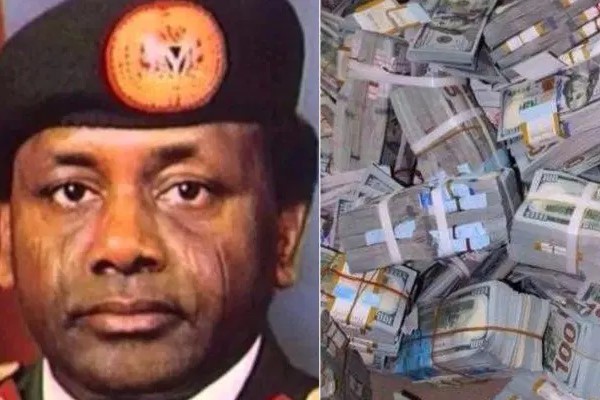
In yet another fresh development, for Nigeria to receive another $9.5 million (£7 million), this time from the United Kingdom’s Jersey, fraud funds linked to former military Head of State, Sani Abacha,
According to the BBC News, Jersey has agreed to repatriate the funds to the Nigerian government.
However, officials describe the money, proceeds of “tainted property”, as part of the vast fortune Sani Abacha stole while ruling Nigeria from 1993 to 1998.
Jersey-Held Funds Locked in Years-Long Legal Battle
A Jersey bank account holds the funds, and courts have subjected them to protracted legal proceedings for several years.
Officials initially recovered the assets during former President Goodluck Jonathan’s administration.
This marked an early effort to reclaim misappropriated funds linked to corruption.
Despite this progress, persistent court challenges significantly delayed repatriation efforts. Legal disputes in foreign jurisdictions prolonged the process for several years.
These proceedings, centered in Jersey, tied up the funds in a bank account amid competing claims. Nigerian authorities navigated complex international legal frameworks to advance recovery.
Ultimately, resolution of these hurdles now paves the way for the assets’ return to Nigeria. This development underscores ongoing commitments to anti-corruption and asset recovery initiatives.
Jersey AG Signs MoU with Nigeria in Dec 2025 for Asset Repatriation
In December 2025, Jersey’s Attorney-General Mark Temple signed a memorandum of understanding (MoU) with Nigerian authorities, enabling repatriation.
The funds were recovered during the tenure of former President Goodluck Jonathan.
This action represented a key milestone in Nigeria’s pursuit of illicitly acquired assets.
However, subsequent legal proceedings abroad halted their repatriation to Nigeria.
Court battles extended over years, complicating the recovery process.
Held in a Jersey bank account, the sum remained frozen amid jurisdictional disputes.
Nigerian officials engaged in prolonged diplomatic and legal efforts to resolve the impasse.
With these challenges now overcome, the assets stand ready for return.
This outcome bolsters Nigeria’s anti-corruption framework and resource recovery endeavors.
Jersey AG Mark Temple Signs MoU with Nigeria for Fund Repatriation
Mark Temple, Jersey’s attorney-general, signed a memorandum of understanding (MoU) with Nigeria in December. The island bank account holds the funds he aims to return.
In a ruling delivered in January 2024, the Royal Court in Jersey held that the funds were “more likely than not” proceeds of corruption.
Finding that third-party contractors diverted public funds “for the benefit of senior Nigerian officials and their associates”.
The money was frozen in 2014 by a Swiss court after a legal procedure against Sani Abacha son, Abba Abacha.
Originally deposited in Luxembourg, it is a fraction of the billions of dollars allegedly looted during his rule from 1993 to 1998.
Recovering the “Abacha loot” has been a major priority for Nigeria.
Buhari’s Asset Recovery Push Yields Nigeria’s Largest Haul Yet
President Muhammadu Buhari made the recovery of stolen assets a major part of his 2015 election campaign and this will be the largest yet.
An agreement to repatriate the funds was formally signed in March.
This pact involved key stakeholders committed to resolving the long-standing issue.
However, legal complications have persistently hindered progress.
Nigeria, World Bank, Switzerland Tackle Asset Return Hurdles
The Nigerian Ministry of Justice, World Bank, and Switzerland continue to navigate these challenges.
BBC correspondent Stephanie Hegarty, reporting from Abuja, highlights the ongoing difficulties.
The trio of institutions grapples with intricate jurisdictional and procedural hurdles.
Despite these obstacles, efforts persist toward full repatriation.
Resolution remains critical for advancing transparency and accountability in asset recovery.
A landmark agreement delineating the repayment terms was executed on Monday.
Representatives from the three key parties formalized the deal at the Global Forum on Asset Recovery (GFAR) in Washington.
This accord directly addresses prolonged delays in repatriation.
It establishes a clear framework for resolving outstanding legal and procedural issues.
The signing marks a pivotal advancement after years of negotiations.
Stakeholders, including Nigeria, have overcome significant barriers to this point.
Consequently, authorities will finally transfer the funds back to Nigeria.
This development reinforces international cooperation in combating illicit finance and corruption.
