


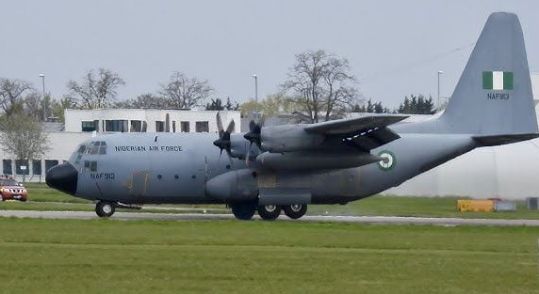
The incident involved a Nigerian Air Force C‑130 transport plane carrying 11 personnel on a mission route to Portugal when the crew decided to divert mid‑flight due to a detected technical concern.
The aircraft, which had departed Lagos, eventually touched down in Bobo‑Dioulasso, Burkina Faso, on 8 December 2025, in what Nigeria insists was a standard safety‑driven diversion.
Technical Emergency Meets Political Tension
According to the Nigerian Air Force, the crew followed established global aviation safety norms by diverting to the nearest available airfield once they noticed the technical issue.
The decision, framed as routine and precautionary, was the kind of professional judgment expected of any military or civilian flight crew dealing with in‑flight anomalies.
Air Commodore Ehimen Ejodame confirmed that Burkinabé authorities received the crew and aircraft without hostility.
Adding that plans were already underway to ensure the mission to Portugal would continue as initially scheduled.
In any other context, this would have ended as a simple aviation footnote: a diversion, a repair, and a cleared onward journey.
However, the landing did not occur in a neutral context.
It happened in a Sahelian airspace that has become hyper‑sensitive, heavily militarised, and politically charged, following a wave of coups and realignments in the region.
That reality quickly turned a technical diversion into a geopolitical talking point.
AES Issues Warning Over Airspace Sovereignty
On the same day as the diversion, the Confederation of Sahel States (Alliance des États du Sahel, AES) publicly expressed displeasure, claiming the aircraft had entered its airspace without prior clearance.
The AES, a military‑aligned bloc comprising Burkina Faso, Mali, and Niger, has increasingly projected a hard line on security and sovereignty since its members broke politically with ECOWAS.
A communiqué broadcast on Burkina Faso’s RTB television by Dr. Émile Zerbo, the country’s Minister of State, cited a prior declaration dated 22 December 2024.
That declaration, signed in Bamako by Mali’s transitional leader and AES President General Assimi Goïta, authorises member states to “neutralise” any aircraft deemed to have violated the confederation’s airspace.
The message was unmistakable.
AES views its skies as a strategic shield, not a corridor for unannounced military flights, and wants the world to understand that it now considers its airspace as serious a frontier as any land border.
Even if no action was taken against the Nigerian aircraft this time, the bloc’s warning underlined that future incidents might not be treated as benign.
Diverging Narratives: Safety Diversion vs. Airspace Violation
From Nigeria’s side, the narrative remains anchored firmly in technical necessity.
The Air Force maintains that the diversion was driven solely by safety concerns and that standard aviation protocols were followed throughout.
The aircraft did not, in Abuja’s view, conduct any hostile manoeuvre or intelligence‑gathering activity, but simply sought the closest safe runway when a problem arose.
Analysts, however, point out that in a region where relations between ECOWAS and AES are already strained by coups, suspensions, and sanctions.
Even a legitimate emergency landing can be read through the lens of suspicion.
In such an environment, technical realities and political perceptions often clash, with each side weaponising narrative to support its broader strategic posture.
The AES communiqué, framed in the language of deterrence and sovereignty, signals that the bloc wants to set a precedent.
No military aircraft, even from a powerful neighbour like Nigeria, should expect leniency if it is perceived as breaching their airspace protocols in the future.
Background: ECOWAS–AES Rift and Militarised Skies
The reaction from AES cannot be separated from its broader context.
Mali, Burkina Faso, and Niger have each experienced military takeovers that triggered political and economic sanctions from ECOWAS and severe diplomatic friction with several West African governments.
In response, the three states have sought closer defence alignment with one another and have distanced themselves from regional structures they now see as unfriendly or meddlesome.
The 2024 Bamako declaration on airspace defence is part of that broader repositioning.
It emphasises a readiness to defend sovereignty “without compromise” and underscores a doctrine where territorial control extends forcefully into the air.
For AES leaders, especially those in transitional military governments, such declarations also serve as domestic messaging tools, portraying them as uncompromising guardians of the nation.
Nigeria, on the other hand, still positions itself as a regional stabiliser, a leading voice in ECOWAS, and a key military actor in West Africa.
The presence of a Nigerian military aircraft in AES territory, even under emergency conditions, will inevitably be seen through the prism of these competing roles and rival alliances.
No Shots Fired, But Message Delivered
For now, the on‑the‑ground reality remains calm.
No confrontation was recorded at the airfield. No shots were fired.
No Nigerian personnel were harmed.
The aircraft landed, was received, and discussions began to ensure the mission would continue.
Yet the absence of overt conflict should not be mistaken for lack of significance.
Under the layer of cordial statements from both sides, a much deeper subtext reverberates across the region: sovereignty in the Sahel is being actively renegotiated.
And the skies are now a crucial theatre in that contest.
Where once overflight permissions and diversions were largely technical questions handled quietly between aviation authorities and defence attachés, they are now potential flashpoints.
Each incident tests where the red lines truly are, and who has the power, and willingness, to enforce them.
Nigeria’s Assurances vs. AES’s Red Lines
Nigeria has moved quickly to reassure its own citizens and regional partners that the mission to Portugal remains on track and that no hostile exchange occurred.
The official line is one of professionalism: the crew made the right safety call, and their Burkinabé counterparts behaved responsibly in facilitating the landing.
Conversely, AES has used the occasion to reiterate that any future “violations” will not be tolerated.
Even without naming Nigeria directly in harsher terms, the bloc has subtly raised the stakes, casting itself as ready to act more aggressively if similar incidents repeat under less benign circumstances.
This dual messaging creates a delicate balance. On one side, a large regional power emphasising normalcy and routine aviation safety.
On the other, a defensive confederation keen to project strength and deterrence.
Between them lies the risk that the next technical diversion, miscommunication, or unannounced overflight could be interpreted as a deliberate provocation.
A Region on Edge, Watching the Skies
The broader consequence of this episode is psychological as much as political.
It reinforces a sense that West Africa’s airspace is no longer a neutral medium.
It is contested, surveilled, and increasingly integrated into strategic calculations, not just for major military operations but even for ordinary transport missions.
For ordinary West Africans, that reality manifests as a gnawing uncertainty.
If a simple emergency landing can trigger regional statements about “neutralising” aircraft, what happens when more complex or ambiguous scenarios arise?
For decision‑makers, it is a reminder that crisis management capabilities and de‑escalation mechanisms are now essential, not optional.
The world, too, is paying attention.
External powers with security and economic interests in the Sahel are likely watching how Nigeria, AES,.
And ECOWAS navigate this moment, gauging whether regional institutions are capable of handling minor incidents without allowing them to spiral into larger confrontations.
The Quiet Hum of a Warning
In the end, this was not a story of jets scrambled or missiles launched.
It was the quieter story of a transport plane, a technical fault, a diverted route, and a loud political echo.
Sometimes peace is not tested by dramatic acts of war but by how calmly states handle a frightened or faulty aircraft in the wrong sky.
The Nigerian C‑130’s landing in Bobo‑Dioulasso, and the AES reaction that followed, has become one such test.
Whether this incident fades as a one‑off scare or becomes a precedent invoked in future disputes will depend on how both sides act from here.
Whether they clarify protocols, improve communication, and cool tempers, or whether they continue to wrap every movement of metal in the air with layers of suspicion on the ground.
For now, the plane rests, the crew is safe, and the mission is set to continue.
But the message has been sent: in today’s Sahel, even the hum of an emergency landing can sound like a warning shot.
