


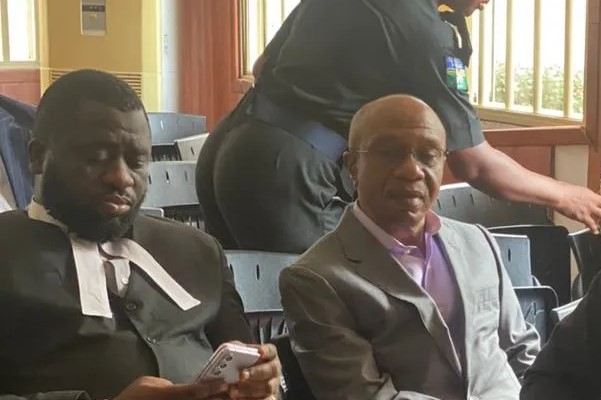
The Ikeja, Lagos, Special Offences Court on Thursday adjourned to Friday, January 16, the trial-within-trial in the ongoing criminal case involving the former Governor of the Central Bank of Nigeria (CBN), Godwin Emefiele.
According reports, Justice Rahman Oshodi fixed the date after hearing further testimony from a defence witness, Nnamdi Offia, during cross-examination by the prosecution counsel, Rotimi Oyedepo (SAN).
Under cross-examination, Offia made a striking admission that reshaped the courtroom narrative.
Emefiele Cautioned in Presence During EFCC Interrogation
He confirmed that Emefiele received a formal caution right in his presence during the intense interrogation led by Economic and Financial Crimes Commission (EFCC) officials.
This procedural step ensured the former Central Bank of Nigeria governor understood his rights amid the probing questions.
Ultimately, Emefiele affixed his signature to the cautionary statement, solidifying its legal weight in the ongoing proceedings.
He acknowledged participating in statement-taking, knowing the second defendant’s words could be used against him in court.
When questioned sharply in court, the witness delivered a clear and unequivocal response that carried significant implications.
Witness Denies Filing EFCC Misconduct Complaint
He was asked if he filed any complaint against EFCC for its team’s alleged misconduct.
This probe aimed to uncover any official grievances about the handling of the case.
The witness firmly answered no, confirming he took no such action despite the serious allegations.
Offia delivered another pivotal admission under the glare of cross-examination, further unraveling key defense claims.
Judge Clears EFCC in Client’s Rights Suit
He conceded judge cleared EFCC of guilt in his client’s fundamental rights enforcement suit.
This ruling dismissed allegations of wrongdoing by the anti-graft agency during the contentious proceedings.
Moreover, to his personal knowledge, Emefiele faced no harassment in Offia’s presence, underscoring a lack of direct evidence for such claims.
Earlier in his testimony, Offia recounted a provocative exchange that heightened the trial’s intrigue before the attentive court.
He alleged that an Economic and Financial Crimes Commission (EFCC) official named Omoile extended assurances to his client during interactions.
These promises reportedly included swift bail and potential avoidance of charges.
EFCC Bail Offer: Incriminate Emefiele for Leniency
This leniency hinged on full cooperation: providing incriminating information targeting the first defendant, Emefiele, in a bid to bolster the prosecution’s case.
The interrogation followed a question-and-answer format, where the second defendant allegedly had to voice investigators’ preferred answers before writing them down.
On several occasions, interrogators put questions to the second defendant, and he answered them.
But interrogators refused to let him write them down because the answers didn’t match what they wanted. I objected to this many times,” Offia said.
Offia alleged February 27, 2024: client interrogated without him; EFCC’s David challenged his query right.
“Tempers rose, and David walked me out of the premises.
I reported the incident to the head of the team, who told me not to worry and asked me to sit in the waiting area,” he testified.
He said he gained access to his client only around 8 p.m., then investigators returned the defendant to detention.
Witness: EFCC said client refused cooperation, denied release; he then applied for bail from EFCC zonal head.
Offia: Second Defendant Detained 21 Days, Sues for Rights
Justice Muslim Hassan granted his client bail but ordered remand at Ikoyi Correctional Centre pending perfection of conditions.
After absorbing the weighty testimony that unfolded in the packed courtroom, Justice Oshodi methodically considered the day’s revelations.
He then formally adjourned the high-stakes matter until January 16, 2026, marking a deliberate pause in the proceedings.
This date aligned precisely with the current day, underscoring the urgency and immediacy of resuming.
The purpose was clear: advance the trial-within-trial, probing contested evidentiary issues central to the case.

2 Comments
Pingback: Diezani UK Bribery Trial Nears Full Proceedings - wahalaupdate
Pingback: Emefiele’s $2.045m Cash, Documents from Lawyer - Witness - wahalaupdate