


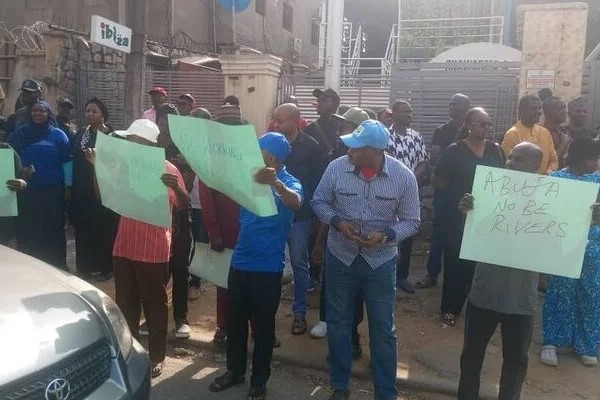
In a decisive ruling that underscores the supremacy of judicial intervention in labor disputes, the National Industrial Court of Nigeria (NICN) in Abuja has ordered members of the Joint Union Action Committee (JUAC) under the Federal Capital Territory Administration (FCTA) to immediately suspend their ongoing strike.
The interlocutory injunction, granted on Tuesday, January 27, 2026, brings temporary relief to the FCT’s public service operations amid escalating tensions over workers’ grievances.
The court’s directive came swiftly in response to a suit filed by the Minister of the Federal Capital Territory, Nyesom Wike, alongside the FCTA, against JUAC Chairman Rifkatu Iortyer and Secretary Abdullahi Umar Saleh.
Marked as suit number NICN/ABJ/17/2026, the case highlights the growing friction between the FCT administration and its workforce, a scenario that has repeatedly disrupted services in Nigeria’s capital city.
Delivering the judgment, Justice E.D. Subilim emphasized that while the matter qualifies as a trade dispute, the union’s industrial action loses legal footing once it reaches the courts.
“An order of interlocutory injunction is hereby granted, restraining the claimants and their representatives from further embarking on any industrial action against the claimant,” the judge ruled.
This order remains in effect pending the resolution of the substantive suit, with the court mandating an immediate return to work.
Justice Subilim further clarified that workers’ rights to protest and strike, enshrined under Nigerian labor laws, are not absolute.
They must yield to due process, particularly when disputes are sub judice, under judicial consideration.
The case has been adjourned to March 23, 2026, for a full hearing on the merits, providing a window for negotiations while enforcing compliance.
Background to the FCT Workers’ Strike
JUAC strike, representing FCTA unions, stems from longstanding grievances over welfare, promotions, and agreements.
Workers in health, education, administration downed tools, citing delayed promotions, wage adjustments, and entitlements.
This action paralyzed Abuja services, from waste management to healthcare, worsening perennial urban maintenance challenges.
The FCTA, responsible for administering Nigeria’s seat of power, employs thousands across 21 area councils and mandates.
JUAC, representing unions like NULGE and NUT, has vocally demanded parity with federal workers.
Union sources allege unresolved core issues despite Wike-led assurances, prompting indefinite strike action.
Minister Wike, known for no-nonsense governance, argued strike unlawful and harmful to public interest.
His legal team argued failed conciliation necessitated court intervention to prevent irreparable FCT infrastructure damage.
Justice Subilim’s Legal Reasoning
Justice Subilim’s ruling relied on precedents under Trade Disputes Act and Nigeria’s 1999 Constitution.
He noted Section 4 prohibits strikes during conciliation or arbitration, a threshold already crossed here.
“Once before court, parties must maintain status quo,” judge affirmed judicial supremacy in industrial relations.
Decision aligns with NICN rulings, including university unions and agencies, prioritizing continuity of essential services.
Subilim balanced workers’ rights under Section 40 of the Constitution, freedom of association, with the public good.
By observing that prolonged strikes in the FCT could undermine national security and economic activities in Abuja.
Critically, the injunction targets not just JUAC leaders but all members and agents, ensuring broad compliance.
Non-adherence could invite contempt proceedings, potentially leading to fines or imprisonment—a deterrent familiar in Nigeria’s labor jurisprudence.
Broader Implications for FCT Governance
This ruling arrives at a pivotal moment for the FCT under Wike’s stewardship.
Former Rivers governor prioritized infrastructure revival, road dualization, and security, yet labor unrest now threatens these developmental gains.
Abuja’s federal territory status heightens stakes: disruptions ripple nationwide, impacting government operations, diplomacy, and tourism significantly.
For residents, strike caused garbage piles, school closures, strained emergency services, issues now paused under court injunction.
However, analysts warn that without substantive resolution, tensions could resurface post-adjournment.
“The court’s order buys time, yet root causes like funding gaps and bureaucratic delays still persist,” noted Dr. Yakubu.
Wike’s intervention reflects a pattern in his administration: swift legal recourse to maintain order.
Similar tactics quelled 2025 protests over land and vendor payments, earning praise for decisiveness but criticism from civil society.
Reactions from Stakeholders
JUAC leadership expressed dismay but pledged compliance pending appeal.
Chairman Rifkatu Iortyer, in a statement post-ruling, urged members to resume duties while vowing to pursue the matter vigorously.
“We respect the court, but our fight for justice continues,” she said, hinting at plans to challenge the injunction.
The FCTA welcomed the decision. A spokesperson described it as a “victory for rule of law,” committing to dialogue.
Minister Wike, yet to comment publicly, is expected to convene stakeholder meetings, building on his track record of town halls.
Civil society organizations, including the Nigeria Labour Congress (NLC), monitored proceedings closely.
NLC President Joe Ajaero praised the court’s balance but cautioned against using injunctions to stifle legitimate demands.
“Workers’ rights must not be sacrificed on the altar of expediency,” he posted on X (formerly Twitter).
Path Forward and Lessons for Nigerian Labor Relations
With the March 23 hearing looming, both parties face pressure to negotiate.
FCTA could use lull to resolve 2022 promotion arrears and align workers with N70,000 minimum wage.
Successful conciliation might avert a full-blown crisis, setting a template for resolving disputes in other territories.
The Trade Disputes Resolution Commission has been urged to intervene proactively.
For JUAC and similar bodies, the ruling serves as a reminder of strategic timing in industrial actions.
Pre-court strikes carry risks, especially in essential services.
Ultimately, Justice Subilim’s injunction restores normalcy while affirming that Nigeria’s courts remain the ultimate arbiter in labor conflicts.
As Abuja revives, stakeholders must prioritize dialogue to prevent standoffs and ensure the FCT remains the nation’s heartbeat.
