


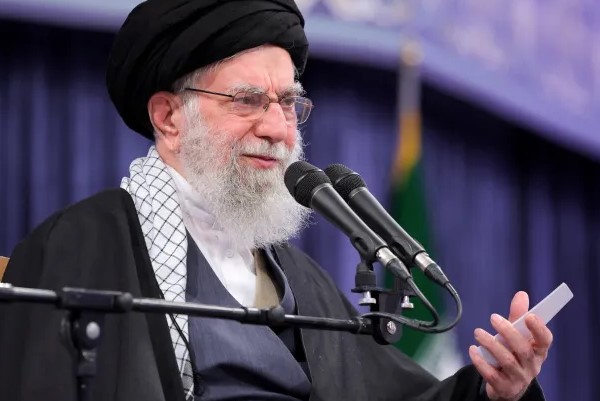
Iranian state media on Sunday confirmed that the country’s Supreme Leader, Ali Khamenei, was killed in joint United States and Israeli airstrikes on Tehran.
According to reports, a 40-day national mourning period has been announced for the 86-year-old cleric, who has led the Islamic Republic since 1989.
US, Israel Claims Confirmed: Khamenei Killed in Strikes
The confirmation followed earlier claims by US and Israeli officials about Khamenei’s death.
He was reportedly killed during coordinated strikes that began early Saturday morning.
Intelligence sources verified the leader’s elimination in a Tehran bunker strike precisely.
Global shockwaves rippled as Iran’s power structure faced sudden upheaval now.
Eyewitness accounts described chaos near the supreme leader’s fortified compound overnight.
Explosions targeted underground facilities where Khamenei allegedly commanded defenses futilely.
US drones and Israeli jets delivered payloads with unerring accuracy amid darkness. Succession questions loomed large over Iran’s shaken leadership cadre immediately.
Israeli PM Hails Khamenei Strike as Decisive Blow Against Threats
Israeli Prime Minister hailed the operation as a decisive blow against threats long-standing.
Pentagon confirmed high-value target neutralization using advanced real-time intelligence feeds.
Khamenei’s death sparked celebrations in some quarters and mourning in others deeply.
Regional alliances shifted amid the seismic geopolitical realignment swiftly.
World leaders urged restraint to prevent wider Middle East conflagration from erupting.
The UN Security Council scheduled emergency sessions on Iran’s destabilized regime Tuesday.
Markets plunged on fears of retaliatory chaos from hardline factions rising.
Confirmation reshaped strategies against nuclear ambitions once spearheaded by Khamenei.
Initial reports by Iran’s Tasnim and Mehr news agencies had that the Supreme Leader remained “steadfast and firm in commanding the field.”
However, state media later confirmed his death at his office in Tehran.
Trump Announces Khamenei’s Death on Truth Social
United States President, Donald Trump, had earlier announced Khamenei’s death in a post on his Truth Social platform.
Trump wrote, “He was unable to avoid our Intelligence and Highly Sophisticated Tracking Systems and, working closely with Israel, there was not a thing he, or the other leaders that have been killed along with him, could do.
“This is the single greatest chance for the Iranian people to take back their Country. Hopefully, the IRGC [Islamic Revolutionary Guard Corps] and Police will peacefully merge with the Iranian Patriots.”
Israeli Prime Minister, Benjamin Netanyahu, had also claimed there were “growing signs” that Khamenei had been killed.
Reuters, quoting a senior Israeli official, earlier reported that Khamenei’s body had been located.
Khamenei’s death is expected to significantly alter the trajectory of the escalating conflict between Iran, the United States and Israel.
Iran Prepared Contingency Plans for Khamenei’s Wartime Assassination
Iranian authorities reportedly prepared contingency plans for his assassination during wartime scenarios.
Despite those measures, analysts say his killing injects fresh uncertainty into chaos.
The volatile situation now risks further escalation amid power struggles internally fierce. Regional stability hangs by a thread as factions vie ruthlessly.
Succession protocols existed on paper, but real-world execution proves far more complex.
Hardliners may seize control, triggering aggressive responses against US and Israeli targets.
Moderate voices struggle to emerge in the leadership vacuum created suddenly.
Fears mount over nuclear site reprisals in coming days ahead.
Analysts highlight risks of proxy militias unleashing widespread attacks across borders now.
Hezbollah and Houthis could intensify operations without Khamenei’s central guiding hand.
Oil routes face heightened threats from disrupted command chains effectively. Global energy markets brace for supply shocks from brewing instability.
Diplomats Push Talks to Contain Khamenei Demise Fallout
US officials monitor closely while preparing defenses against potential retaliation waves.
Uncertainty dominates as Iran’s future pivots on unpredictable internal dynamics.
Khamenei Rose as Supreme Leader After Khomeini in 1989
Khamenei became Iran’s Supreme Leader in 1989, succeeding Ruhollah Khomeini seamlessly.
Khomeini had led the 1979 Islamic Revolution that toppled the Shah dramatically.
This pivotal shift established the Islamic Republic amid widespread popular uprisings fierce.
Khamenei’s rise marked continuity in revolutionary ideology and governance firmly.
Under Khomeini’s guidance, protesters overthrew the monarchy after decades of authoritarian rule.
Mass demonstrations and strikes paralyzed the Shah’s regime, forcing his eventual exile abroad.
Clerics seized power, blending Shia theology with anti-Western rhetoric powerfully.
The revolution reshaped Iran’s trajectory on the global stage forever.
Ex-President Khamenei Ascended to Supreme Power After Khomeini’s Sudden Death
Khamenei, once president, ascended to supreme authority after Khomeini’s passing suddenly.
He consolidated control over military, judiciary, and religious institutions strategically over decades.
Policies hardened against Israel and the US, fueling proxy conflicts regionally.
His long tenure defined Iran’s defiant stance amid sanctions relentless.
Khomeini’s legacy inspired hardline theocracy that Khamenei upheld unwaveringly until his end.
The 1979 upheaval ended Pahlavi dynasty’s modernization efforts tied to Western allies.
Revolutionaries imposed strict Islamic laws, transforming society and foreign relations profoundly.
Khamenei’s death revives debates on that enduring revolutionary path now.
