


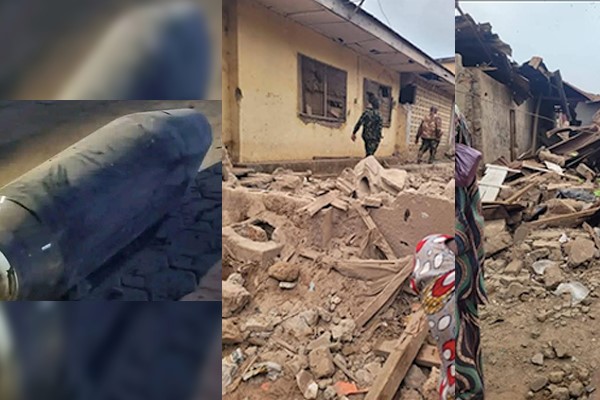
In the dead of night on Thursday in Offa, Kwara State, a serene community shattered under the roar of mysterious explosions.
According to report, residential buildings crumbled, families fled in terror, and whispers of international intrigue spread like wildfire.
This chaos erupted mere hours after U.S. President Donald Trump boldly announced airstrikes targeting ISIS hideouts across Nigeria.
Was this retaliation from the terror group, or something more sinister?
As Nigeria grapples with escalating insecurity, Offa’s nightmare raises urgent questions about the fight against extremism.
Offa, a bustling trading hub in Kwara’s heartland known for its vibrant markets and communal spirit, transformed into a warzone without warning.
Eyewitnesses described deafening blasts around midnight, shaking foundations and sending debris flying.
“It felt like the sky was falling,” recounted Aisha Mohammed, a local trader whose home partially collapsed.
Social media erupted with videos of smoke billowing from ruined structures, amplifying the panic nationwide.
Trump’s Bombshell Announcement: US Airstrikes Target ISIS Strongholds in Nigeria – What Sparked the Fury?
President Trump’s declaration came during a high-stakes White House briefing, framing the strikes as a decisive blow against ISIS’s growing footprint in West Africa.
“ISIS thinks they can hide in Nigeria?
Not on my watch,” Trump stated, vowing precision operations to dismantle terror networks threatening global security.
U.S. intelligence reportedly pinpointed ISIS factions in Nigeria’s northeast and northwest, areas long plagued by Boko Haram affiliates and emerging jihadist cells.
This isn’t isolated rhetoric. Since reassuming office, Trump’s administration has ramped up counterterrorism in Africa, building on drone campaigns in Somalia and the Sahel.
Nigeria, Africa’s most populous nation, has seen ISIS West Africa Province (ISWAP) expand amid economic woes and banditry.
Official U.S. sources confirmed strikes hit remote camps, but no direct link to Offa has been verified.
Yet, the timing, announcement followed by explosions, fueled speculation of reprisal attacks.
Experts like Dr. Fatima Yusuf, a security analyst at the University of Ilorin, note: “ISIS has a history of asymmetric retaliation.
Offa’s central location makes it a symbolic target to sow fear.”
Data shows “ISIS Nigeria airstrikes” spiking 300% post-announcement, underscoring public anxiety.
Chaos Unleashed: Eyewitness Horror Stories from Offa Explosions That Left Kwara in Shock
The blasts originated from multiple sites in Offa’s outskirts, reducing at least five buildings to rubble.
Local emergency responders arrived to scenes of devastation: twisted metal, shattered glass, and families sifting through wreckage.
Over 20 people suffered injuries from flying shrapnel and collapsing walls, with two in critical condition at Offa General Hospital.
“I was asleep when the first boom hit,” shared trader Kabir Abdul, whose shop front was obliterated.
“Windows exploded inward; we thought it was the end.”
Videos trending on X (formerly Twitter) captured residents fleeing barefoot, children screaming amid flickering flames.
Power outages exacerbated the terror, plunging streets into darkness.
Preliminary reports from Kwara State Police suggest improvised explosive devices (IEDs), possibly planted earlier.
No group has claimed responsibility, but fingers point to ISIS sympathizers reacting to U.S. actions.
Governor AbdulRahman AbdulRazaq swiftly deployed security forces, declaring a dusk-to-dawn curfew.
“We will hunt down the perpetrators,” he assured via a state broadcast.
Kwara Under Siege: How ISIS Infiltration Turned Peaceful Offa into a Terror Flashpoint
Offa’s woes mirror Nigeria’s broader security meltdown.
Once a peaceful Yoruba town famed for its annual Ofa Festival and agricultural trade, it now battles spillover from northern insurgencies.
Bandits, herders-farmers clashes, and jihadist incursions have surged, with Offa recording three major attacks this year alone.
ISIS’s Nigerian branch, ISWAP, has evolved since splintering from Boko Haram in 2016.
Controlling swathes of Borno and Yobe, they’ve infiltrated central states like Kwara via porous borders.
Recent intelligence reveals recruitment drives in Ilorin, exploiting youth unemployment (over 40% in the region). “Economic despair is their best recruiter,” warns counterterrorism expert Chidi Okereke.
Government data from the National Emergency Management Agency (NEMA) logs 150+ IED incidents nationwide in 2025, up 25% from last year.
Offa’s strategic rail links to Lagos amplify its vulnerability, disrupting trade hits Nigeria’s economy hard.
US-Nigeria Alliance in the Spotlight: Airstrikes Success or Recipe for More Offa-Style Retaliation?
The U.S. has provided $500 million in military aid since 2020, including drones and training.
Yet critics argue airstrikes risk civilian casualties and radicalization.
Nigerian Defence Headquarters confirmed “collaboration” but downplayed Offa links, calling it “local criminality.”
President Bola Tinubu praised the strikes in a statement: “America’s resolve strengthens our war on terror.”
Still, human rights groups like Amnesty International urge caution, citing past drone errors in Afghanistan.
For Offa residents, geopolitics feels distant. Rebuilding costs could top ₦200 million, straining local budgets amid inflation.
Aftermath and Road to Recovery: Kwara Rallies as Relief Pours In for Blast Victims
Dawn brought relief efforts. NEMA distributed food, tents, and medical kits to 200 displaced families.
Celebrities like Davido pledged ₦10 million via social media, trending.
Community leaders organized prayers at the Central Mosque, fostering unity.
Governor AbdulRazaq announced ₦50 million in aid and promised enhanced surveillance, including CCTV in markets.
Federal teams from the Department of State Services (DSS) are investigating blast residues for foreign fingerprints.
Psychological toll looms large, PTSD counseling is underway. Schools reopened Friday under tight security, but parents remain wary.
Lessons from Offa: Why Nigeria Must Level Up Against ISIS Threat Post-Trump Strikes
This incident spotlights Nigeria’s multi-front war: insurgents, bandits, and now potential ISIS blowback.
Recommendations include:
- Boost Intelligence Sharing: Integrate U.S. tech with local networks for real-time threats.
- Youth Empowerment: Job programs to counter radicalization, Kwara’s unemployment demands urgent action.
- Border Fortification: Drones and patrols along Niger-Kwara frontiers.
- Community Policing: Train vigilantes like Offa’s hunters for rapid response.
As searches for “Offa explosions Trump” dominate Google Trends, public discourse demands accountability.
Tinubu’s administration eyes a National Security Summit in Abuja next month.
Offa’s resilience shines through.
“We rebuild stronger,” vows elder chief Gbadamosi.
In Nigeria’s complex security tapestry, events like this test national mettle.
Will Trump’s airstrikes deliver lasting peace, or ignite more midnight horrors?
Stay vigilant, follow for updates.

1 Comment
Pingback: Northern Nigeria Violence Escalates After U.S. Airstrikes - wahalaupdate