


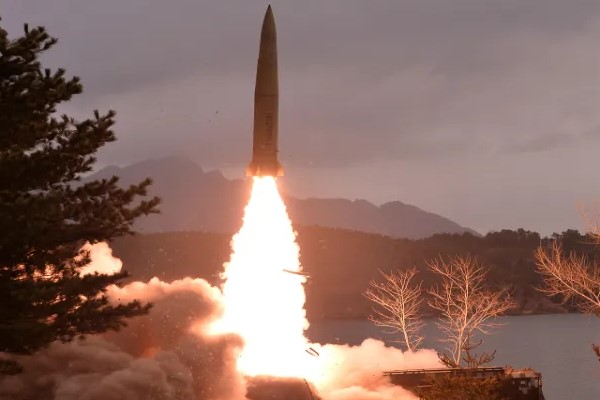
Authorities in Japan raised an alarm after North Korea reportedly launched a suspected ballistic missile on Saturday morning. Sirens blared across Tokyo, urging citizens to seek shelter amid rising fears of escalation.
The missile arced over the Sea of Japan, prompting Japan’s Self-Defense Forces to scramble jets for interception.
Japan PM Scrambles as Missile Nears EEZ
Prime Minister’s office convened urgently, monitoring trajectory toward the exclusive economic zone.
International allies, including the US and South Korea, condemned the provocative act.
Analysts warn this test heightens regional tensions, potentially derailing fragile diplomatic talks on denuclearization.
The development was disclosed by the office of the Japanese prime minister in a message posted on its verified account on the social media platform 𝕏.
Officials said the situation was still being monitored while further details about the missile were being gathered.
In the brief message shared online, the Prime Minister’s Office alerted the public to the missile launch.
“North Korea has launched a suspected ballistic missile. More updates to follow,” the statement read.
Missile Post Withholds Trajectory, Landing Details
The post did not immediately provide information about the missile’s trajectory or where it might have landed.
This vagueness fueled speculation across Japanese media and social platforms amid heightened public anxiety.
Military radars tracked the launch from North Korea’s east coast, but officials withheld splashdown coordinates to avoid panic.
Emergency alerts focused solely on preparedness rather than precise threat details.
As analysts pored over satellite imagery, South Korean intelligence hinted at a Sea of Japan fall.
The opacity underscores Pyongyang’s strategy of sowing uncertainty in regional security dynamics.
Japanese authorities said further updates would be issued as investigations continue.
NKorea’s Missile Barrage Provokes Regional Fury
North Korea has carried out several missile launches in recent years, drawing strong reactions from Japan and other countries in the region.
Such tests are closely monitored by neighbouring states and international partners due to concerns over regional security and stability.
Ballistic missile launches by North Korea have often triggered emergency alerts in Japan and heightened military surveillance across East Asia.
Sirens wail in Okinawa, evacuating coastal communities swiftly.
US Carriers, SKorea Defenses Surge Against NK Launch
US carrier groups reposition in the Pacific, while South Korea activates its missile defense systems in real-time response.
Japan’s Aegis destroyers track inbound threats with precision radar sweeps.
These tests defy UN resolutions, escalating rhetoric from Pyongyang’s leadership.
Diplomats scramble for de-escalation, as markets jitter over potential supply chain disruptions in tech-heavy region.
NK Launch Exploits US-Iran Middle East Clash
The reported launch comes at a time of heightened global tensions, particularly in the Middle East, where United States and Iran clash militarily.
Resources stretch thin across multiple fronts.
Pyongyang exploits distractions, timing provocations when Western focus shifts to Persian Gulf skirmishes and oil route threats.
Analysts see calculated opportunism in this strategic window.
As US carriers divert toward Hormuz Strait, Pacific defenses thin out, emboldening North Korea’s missile program advances.
Global markets plunge on fears of multi-theater instability.
US-Israel Airstrikes Ignite Iran Clash in Feb
The confrontation escalated in late February 2026 following coordinated airstrikes by U.S. and Israeli forces targeting Iranian military and strategic installations.
Iran responded with missile and drone attacks on Israeli territory, U.S. military bases and allied Gulf states.
Iran-backed groups, including Hezbollah, have also been involved in the fighting.
The conflict disrupted activities around Strait of Hormuz, a critical route for global oil shipments from Saudi Arabia and UAE.
Tankers reroute, spiking insurance premiums skyward.
Naval skirmishes force closures, idling supertankers laden with crude amid Iranian mine threats and US escort demands.
Refineries scramble for alternatives from distant fields.
Global Pump Prices Surge as OPEC Scrambles
Prices surge at pumps worldwide, from Lagos to London, as OPEC debates emergency quotas.
Economies brace for inflation tied to this chokepoint’s prolonged turmoil.
The situation has raised fears of potential disruptions to global energy supplies and increased geopolitical instability.
Casualties mounted on both sides of the conflict, including U.S. service members and civilians in affected areas.
Drone strikes claimed sailors aboard patrolling destroyers in Gulf waters.
Families grieve losses amid relentless tit-for-tat escalations.
Aid Rushes to War-Torn Borders Amid Blackouts
Humanitarian agencies rush aid to border towns, treating burns and shrapnel wounds under blackout skies.
Toll rises daily, straining medical facilities in neighboring Iraq and Oman.
With no formal ceasefire in place, military operations continue as parties monitor developments and respond to ongoing threats.
Night raids pierce darkness over contested desert frontiers relentlessly.
US Strikes Iranian Depots, Face Guerrilla Ambushes
Intelligence drives preemptive moves around the clock.
Diplomatic backchannels flicker dimly amid escalations, with envoys trading accusations over stalled Geneva talks.
Battle rhythm persists, grinding toward unknown resolution horizons.
