


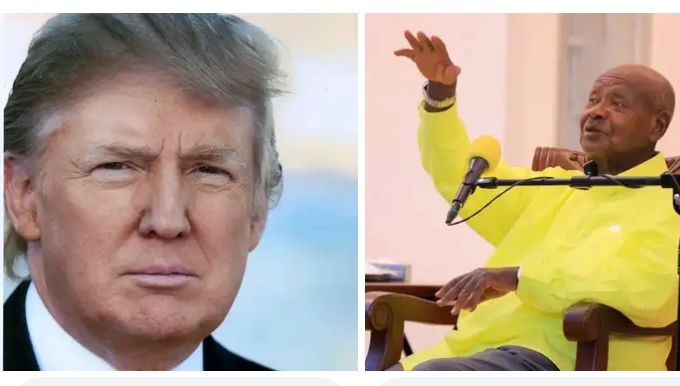
President of Uganda, Yoweri Museveni has said that while the United States possesses overwhelming military superiority, including dominance at sea, in the air, and in space, it could still be harmed in a ground confrontation.
Museveni linked this to lessons from U.S. actions in Venezuela.
He made the remarks while responding to a journalist’s question on Pan-Africanism and what Africa can learn from Washington’s recent military intervention in Venezuela.
Saying he was still studying developments in the South American country, Museveni noted that the situation nonetheless exposed critical gaps in the global security balance.
“I’m still watching and studying it. We shall learn more. But whatever the case is, you can see the gaps,” he said.
The Ugandan leader argued that U.S. military strength lies in its ability to operate simultaneously across four domains—sea, air, space, and land—unlike many countries it confronts.
“The Americans are operating in four dimensions. They are on the sea. The Latin Americans are not there; they don’t have a navy,” Museveni said.
He added that the United States also dominates the air and space domains, giving it a decisive advantage long before any direct contact.
However, Museveni stated that ground operations reduce that advantage and expose even powerful militaries to harm.
“Now they are trying to come on land, which of course is very risky for the Americans as well,” he said. “There, you come near, because even me, who has only short range, I can harm you.”
Museveni explained that even on land, the imbalance persists because of U.S. surveillance and technological superiority.
“You are seeing me from space; I’m not seeing you. You are in the ocean; I’m not there. I’m here,” he said, underscoring how weaker states are exposed across multiple fronts.
He said this strategic asymmetry is at the heart of Africa’s vulnerability and a key argument for continental unity.
Museveni traced the problem back to the failure of early Pan-African leaders to pursue collective security after independence.
“That was our target in 1963,” he said, referring to the push for African unity.
According to him, the vision faltered because of political self-interest.
“Mwalimu (Julius Nyerere) was ready to move, but (Jomo) Kenyatta and (Apollo Milton) Obote decided to remain big fish in small ponds,” Museveni said.
He concluded that the crisis in Venezuela illustrates why Africa must revive Pan-African cooperation, particularly in security, to avoid remaining strategically exposed in an increasingly militarized global order.

1 Comment
Pingback: Maduro Defies NY Court: "Not Guilty, Still Venezuela's President" - wahalaupdate