


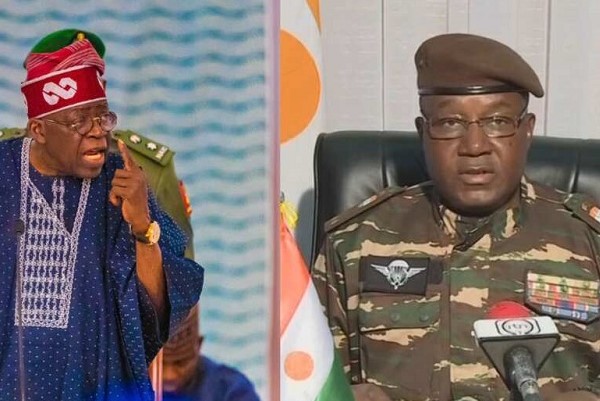
In an unprecedented and bold display of regional cooperation, President Bola Ahmed Tinubu has publicly praised Nigeria’s military for its quick and courageous intervention in the Republic of Benin following a failed coup attempt on December 7, 2025.
According to the statement delivered by Tinubu’s Special Adviser on Information and Strategy, Bayo Onanuga, from the nation’s capital Abuja, Tinubu celebrated the military’s gallantry while also reinforcing Nigeria’s self-appointed role as West Africa’s democratic watchdog and security guarantor.
The crisis, which shook Benin’s fragile 35-year-old democracy at dawn that Sunday, was met with decisive action by Nigerian forces, acting on official requests from Beninese authorities.
A Regional Shock: Coup Attempt in Benin Republic
On the morning of Sunday, December 7, chaos engulfed Cotonou as a group of military officers, led by Colonel Pascal Tigri, brazenly announced a coup.
They seized control of the national television station, the primary information channel, and declared the suspension of democratic institutions.
Colonel Tigri boldly claimed the ousting of President Patrice Talon, shaking the foundations of a country that has managed relative stability in the region for more than three decades.
This sudden disruption triggered alarm beyond Benin’s borders.
The events not only threatened Benin’s constitutional governance but also raised concerns about potential regional instability.
The popular West African democracy seemed to be on the brink of collapsing under authoritarian ambitions.
Nigeria’s Swift Response: Military Aid and Air Support
Within hours of the attempted coup, the Government of Benin formally addressed Nigeria’s military leadership with urgent and separate appeals.
The first request, conveyed through a Note Verbale from Benin’s Ministry of Foreign Affairs, asked for fighter jets to enter Beninese airspace to assist in dislodging the rebellious officers entrenched in the national television facility and a military camp.
Additionally, a second urgent appeal sought not only air reconnaissance but also the deployment of ground forces for surveillance and rapid reaction, all coordinated under Beninese command.
The aim was to stabilize the situation, protect constitutional institutions, and ensure the safety of Benin’s citizens.
Demonstrating compliance and swift action, Nigeria’s Chief of Defence Staff, General Olufemi Oluyede, confirmed that all requests were honored.
Nigerian Air Force jets entered Benin Republic’s airspace quickly, while ground troops were already deployed on Beninese soil to support loyalist forces.
“Ours is to comply with the order of the Commander-in-Chief of our Armed Forces, President Tinubu,” General Oluyede announced.
This cooperation highlights Nigeria’s extensive military reach and its commitment to regional democratic stability.
Nigeria’s Role as Regional Police
Many ask: should Nigeria act as the self-declared guardian of democracy in neighboring countries?
Or does such intervention risk perpetuating a cycle of military influence in civilian governance, ironically undermining democracy?
Critics argue that by responding militarily to political crises in neighboring states, Nigeria may be edging into neo-imperialist territory, blurring the lines between assistance and intrusion.
Others see it as a strategic necessity, given regional threats and instability spreading from weak governance.
Promotion of peace and democracy should not, some contend, be a justification for unilateral military actions, even if requested.
The balance between sovereignty and regional security is delicate and demands transparent and accountable multilateral frameworks rather than reactive interventions.
Praise Amid Political Theatre
In his statement, President Tinubu hailed the Nigerian Armed Forces as defenders of democracy, acting with respect to the ECOWAS Protocol on Democracy and Good Governance. He stated:
“Today, the Nigerian Armed Forces stood gallantly as a defender and protector of constitutional order in the Republic of Benin on the invitation of the government.
Our Armed Forces acted within the ambit of the ECOWAS Protocol on Democracy and Good Governance.”
He further extolled the military’s commitment since Nigeria’s own return to democracy in 1999, framing the intervention as a continuation of Nigeria’s leadership role in West African stability.
Impact on Regional Security and Democracy
The rapid suppression of the coup restored Benin’s constitutional order.
Loyalist forces regained control after fierce confrontations supported decisively by Nigerian air and ground presence.
This incident spotlights the fragile nature of democracy in parts of West Africa.
Despite decades of governance, countries like Benin remain vulnerable to military insurrection.
The involvement of Nigeria hints at wider regional fears of democratic backsliding and the threat posed by unruly military factions.
However, questions linger about whether military solutions address the root causes.
Public Reactions and Online Debate
News of Nigeria’s intervention sparked diverse reactions across social media and political circles.
Supporters applauded the swift defense of democracy and viewed Nigeria’s actions as noble.
Critics, however, condemned the military incursion as dangerous encouragement of military solutions and interference in sovereign affairs.
Some questioned Nigeria’s motives, whether the action was truly altruistic or driven by geopolitical interests.
Others called for stronger regional institutions to manage crises diplomatically, avoiding the dangers of military heavy-handedness.
What Does This Mean for Nigeria’s Future Role?
Nigeria faces a critical strategic crossroads.
Its military’s role in securing democracy beyond national borders bolsters its leadership but also risks backlash amid fears of overreach.
This intervention could redefine Nigeria’s position as West Africa’s “regional policeman” at a time when domestic priorities compete with external security responsibilities.
Interactive Questions:
- Should Nigeria continue intervening militarily in neighboring countries facing democratic crises?
- Is the risk to national sovereignty justified by the need to protect democracy in West Africa?
- Could stronger regional institutions replace military intervention as a means of resolving political instability?
Join the conversation

3 Comments
Pingback: President Tinubu Credits Buhari Coalition for Historic 2015 Victory - wahalaupdate
Pingback: Benin Military Ousts President Talon, Seizes Power - wahalaupdate
Pingback: Army Urges South-East Youths to Join, Laments Low Recruitment - wahalaupdate