


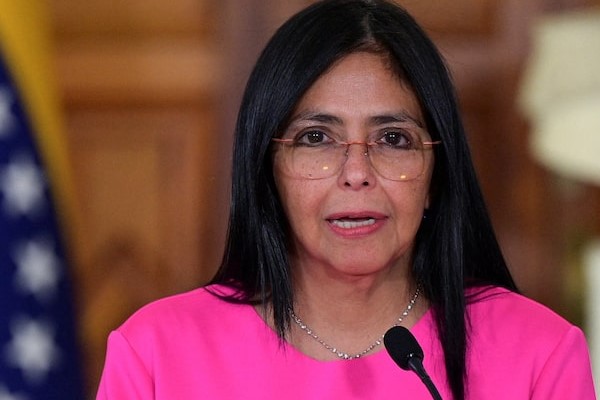
Venezuela’s political landscape shifted dramatically this week with the appointment of Calixto Ortega Sánchez, a veteran central banker, as the new Minister of Economy.
Interim President Delcy Rodríguez made the announcement on Tuesday, signaling a strategic pivot to stabilize the nation’s battered finances amid unprecedented international pressure.
This move replaces Rodríguez herself in the Economy role she held prior to her ascension following the ouster of Nicolás Maduro.
Strategic Appointment Amid Political Upheaval
Delcy Rodríguez, serving as Interim President since Monday, tapped Calixto Ortega Sánchez for the pivotal Minister of Economy position.
Sánchez previously led Venezuela’s Central Bank from 2018 to 2025, bringing deep expertise in monetary policy and the oil sector, Venezuela’s economic lifeline.
Rodríguez, who directly managed the economy as Vice President under Maduro, now delegates these duties to focus on presidential leadership.
The timing underscores urgency.
Just two days prior, a bold U.S. military operation captured Maduro, extraditing him to New York for trial on charges including corruption and human rights abuses.
This intervention, executed under President Donald Trump’s administration, dismantled Maduro’s regime and elevated Rodríguez, a longtime Maduro ally, to interim leadership.
Her swift cabinet reshuffle aims to project continuity while addressing economic woes that have plagued Venezuela for over a decade.
Sánchez’s track record positions him ideally for the role.
During his Central Bank tenure, he navigated hyperinflation, currency collapse, and U.S. sanctions by implementing pragmatic reforms.
His oil industry experience, including stints at state-owned PDVSA, equips him to maximize Venezuela’s 300 billion barrels of proven reserves, the world’s largest.
Rodríguez praised his “proven competence” in a state television address, framing the appointment as essential for sustaining momentum.
Economic Context and Recent Reforms
Venezuela’s economy has endured a brutal cycle of booms and busts, largely tied to oil dependency.
The 2014 price crash triggered a depression, with GDP contracting over 75% by 2021.
Hyperinflation peaked at 1.7 million percent in 2018, eroding savings and fueling mass emigration, over 7.7 million Venezuelans fled by 2025.
Rodríguez, Vice President since 2018, spearheaded recovery efforts.
She championed partial dollarization, allowing U.S. dollars to circulate alongside the bolívar, which curbed inflation from triple-digit monthly rates to single digits by mid-2025.
Loosened exchange controls enabled market-driven rates, boosting private sector activity.
Oil production rebounded from 300,000 barrels per day in 2021 to 900,000 by late 2025, aided by Chevron’s licensed operations under U.S. sanctions relief.
These measures yielded results.
ECLAC projects 6.5% GDP growth for 2025, driven by hydrocarbons and non-oil sectors like agriculture and manufacturing.
Poverty rates fell from 96% in 2019 to around 50% last year, per ENCOVI surveys, though inequality persists.
Rodríguez highlighted these gains on television: “We consolidate progress amid challenges, guided by data and determination.”
Yet risks loom. The bolívar depreciates rapidly, losing 40% against the dollar in Q4 2025, sparking hyperinflation fears.
Food and medicine shortages linger, with 30% of households food-insecure per WFP reports.
Sanctions, though partially eased, cap oil exports to China and India at discounted rates.
International Scrutiny and U.S. Relations
Rodríguez’s government faces intense global watch.
President Trump, referencing Maduro’s arrest, demands “total access” to Venezuelan oil as a cooperation precondition.
Trump accused Maduro of “copying his dance steps” in a colorful X post, blending levity with policy signals.
Washington views Rodríguez warily due to her Maduro ties but sees opportunity in her pragmatism.
The U.S. raid, codenamed Operation Libertad, marks a escalation from sanctions to direct action.
SEAL teams extracted Maduro from Caracas, citing extradition warrants.
This bolsters Trump’s 2025 reelection narrative on Latin America, promising normalized ties if Rodríguez delivers democratic reforms, asset transparency, and counters Chinese influence.
Regionally, Brazil and Colombia pledge support, conditional on elections by 2027.
The OAS and UN urge inclusive dialogue.
Challenges Ahead for Sánchez and Rodríguez
Sánchez inherits a fragile rebound. Key priorities include:
-
Stabilizing the Currency: Formalize dollarization while rebuilding Central Bank reserves, depleted to $500 million.
-
Oil Sector Revival: Negotiate sanction relief for full PDVSA operations, targeting 2 million barrels daily.
-
Diversification: Boost agriculture (coffee, rice) and tourism, reducing oil reliance from 95% of exports.
-
Fiscal Discipline: Cut subsidies costing 10% of GDP; rationalize 6 million public workers.
-
Anti-Corruption: Audit PDVSA amid $20 billion embezzlement probes.
Hyperinflation risks persist if oil prices dip below $60/barrel.
Emigration strains remittances, $4 billion annually, but sustains consumption.
Political instability, including opposition protests, tests governance.
Rodríguez’s rhetoric emphasizes resilience: “No familiarity sways justice; principles endure.”
Broader Implications for Latin America
Venezuela’s pivot reverberates.
Success under Sánchez could model sanctioned economies’ recovery, inspiring Cuba and Nicaragua.
Failure risks refugee surges to Colombia (2.5 million hosted) and humanitarian crises.
Trump’s intervention redefines U.S. policy, prioritizing energy security over ideology.
With global oil demand rising, Venezuela’s fields allure ExxonMobil and others, potentially flooding markets and lowering prices.
ECLAC’s optimistic forecast hinges on stability. If realized, 6.5% growth lifts regional averages, fostering trade.
Yet, uncertainty prevails, currency woes and geopolitics could derail progress.
Rodríguez and Sánchez face a defining moment.
Their success depends on pragmatic governance, international buy-in, and oil windfalls.
Venezuela, long a cautionary tale, now tests redemption amid high-stakes drama.

1 Comment
Pingback: US: Strike on Venezuela Sparks Global Alarm as UN Warns - wahalaupdate % %