


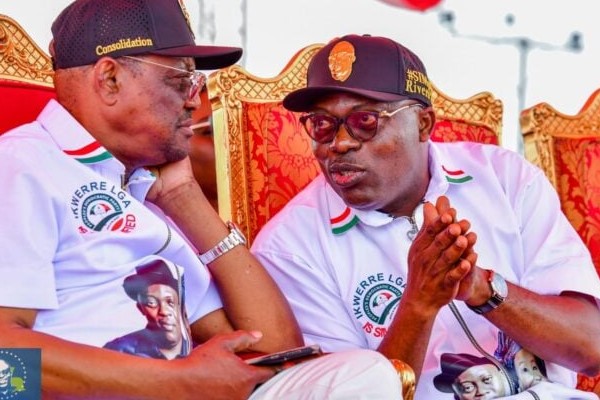
The protracted political crisis in Rivers State escalated on multiple fronts Friday, with the Presidency throwing its weight behind Governor Siminalayi Fubara, while a High Court in Port Harcourt delivered a major setback to the impeachment moves against him.
In a decisive political intervention, President Bola Ahmed Tinubu openly declared support for Governor Fubara.
Tinubu via Bwala: Wike Compensated, Can’t Override Nigeria’s Interests
Speaking through his Special Adviser on Media and Policy Implementation, Daniel Bwala, the President stated that the immediate past governor and current Minister of the Federal Capital Territory, Nyesom Wike, “has been adequately compensated and cannot do more at the expense of the interest of Nigeria.”
President Tinubu declared Governor Fubara the undisputed party leader in Rivers State during the key endorsement event.
He warned that no one should obstruct Fubara from fulfilling his constitutional duties without repercussions.
This endorsement comes as the legal avenue for removing the governor was put on hold.
Oyigbo High Court, under Justice Florence Fiberesima, adjourned sine die the suit by Governor Fubara and Deputy Ngozi Nma-Odu.
The case challenges impeachment proceedings launched by the State House of Assembly against the governor and his deputy indefinitely.
Justice Fiberesima Adjourns Case Due to Pending Appeals
Justice Fiberesima ruled that the adjournment was necessary because two separate appeals had been entered in relation to the case.
She emphasized that a trial court must exercise restraint once litigants properly enter an appeal, avoiding judicial impropriety or actions conflicting with the appellate court’s jurisdiction.
Court Freezes Impeachment, Prolongs Wike-Loyal Faction Standoff
The court’s decision effectively freezes the impeachment litigation, prolonging the standoff between the executive and the faction of the legislature loyal to Minister Wike.
The Oyigbo High Court’s ruling follows its prior interim injunction restraining Speaker Amaewhule, 26 lawmakers, Clerk, and Chief Judge.
It barred further impeachment steps, including sending articles to the Chief Judge for any processing or action.
Background
Rivers State’s political crisis is a multifaceted power struggle over succession and a shattered once-powerful alliance.
At its core, the conflict is a dramatic fallout between a political godfather, Nyesom Wike, and his anointed successor, Governor Siminalayi Fubara.
Wike, the formidable former governor and now Minister of the Federal Capital Territory, engineered Fubara’s rise to power, expecting to retain considerable influence over the state’s affairs.
However, Governor Fubara’s subsequent pursuit of autonomy and the establishment of his own independent political identity shattered this expectation.
Intense Feud Erupts Over State Resources, Political Control
Sparking an intense feud for control of the state’s vast resources and political machinery.
This power struggle quickly found its primary battlefield in the hallowed chambers of the Rivers State House of Assembly.
The legislative body, dominated by lawmakers loyal to Wike, transformed into the chief instrument for challenging the governor’s authority.
The crisis escalated from procedural skirmishes to open confrontation, marked by an attempted change in leadership.
Amysterious fire at the assembly complex, and ultimately, the defection of twenty-seven pro-Wike lawmakers to the rival All Progressives Congress.
This move created a paralyzing legitimacy crisis, with Governor Fubara declaring their seats vacant while the faction, led by Speaker Martin Amaewhule.
Continued to assert its authority and relentlessly pursued impeachment proceedings against the governor.
In a bid to forestall a complete institutional breakdown, the federal government, under President Bola Tinubu, intervened to broker a peace agreement between the warring parties.
Pact Demands Impeachment Withdrawal, Backs Pro-Wike Faction
The pact aimed to restore calm by mandating the withdrawal of impeachment notices and recognizing the leadership of the pro-Wike assembly faction.
Nevertheless, this truce proved to be a fragile ceasefire rather than a lasting peace.
The underlying tensions and mutual distrust remained unaddressed, leading to a swift resumption of hostilities as impeachment threats re-emerged.
Revealing the profound and perhaps irreconcilable nature of the rift.
The conflict has now metastasized into a protracted stalemate fought across multiple arenas.
While the political and verbal warfare continues unabated, the legal system has become a critical theatre of conflict.
Courts Flooded with Suits; Gov’s Impeachment Case Adjourned Indefinitely
This judicial intervention has temporarily frozen the legislative onslaught but has also prolonged the uncertainty.
Leaving the state in a tense limbo where governance is perpetually secondary to political survival.
Recently, the calculus of the crisis has been fundamentally altered by a decisive shift in federal alignment.
Presidency Backs Fubara, Challenges Wike’s Rising Influence
This endorsement not only bolsters Fubara’s position but elevates the feud to national political battleground status prominently.
This endorsement strengthens the governor’s political standing significantly while redefining the feud from local to national dimensions entirely.
