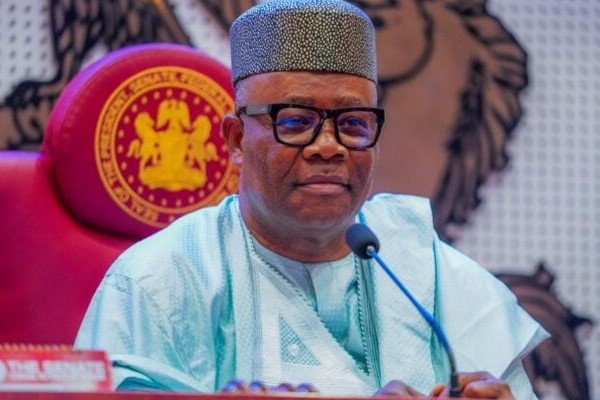
Senate President Godswill Akpabio sharply responded to protesters criticizing the 2026 Electoral Act Bill. He urged critics to read the full legislation before condemning the National Assembly’s reforms.
The bill scraps mandatory real-time transmission of election results, sparking widespread backlash.
Akpabio: Electoral Changes Boost Integrity, Fix Result Challenges
Akpabio dismissed attacks, insisting the changes strengthen electoral integrity and address practical challenges in result management.
Protesters gathered, decrying the decision as a setback for transparency.
Akpabio countered that uninformed outrage ignores the bill’s comprehensive provisions designed to enhance Nigeria’s democratic processes overall.
He emphasized studying the document to grasp its intent fully.
This rebuttal highlights ongoing tensions between lawmakers and activists over electoral reforms amid Nigeria’s political landscape.
Akpabio Addresses Senate Post-Electoral Act Passage Tuesday
Senate President Godswill Akpabio spoke post-plenary on Tuesday after Senate passage.
The session adopted votes, proceedings, then approved the contentious 2026 Electoral Act Bill swiftly.
He robustly defended key amendments in the legislation.
Akpabio highlighted how changes address flaws, ensuring smoother operations for Nigeria’s electoral system in upcoming cycles.
The bill aims to fortify processes before 2027 elections.
Akpabio: Reforms Boost Efficiency, Security, Trust in Elections
Akpabio stressed improvements in efficiency, security, and credibility to bolster public trust in democratic outcomes nationwide.
Critics remain vocal, but Akpabio insists reforms are progressive.
This defense underscores Senate’s commitment to refining electoral laws for fairer, more reliable polls ahead.
“After today, elections in 2027, if this is assented to and accompanied by the President, will be very smooth, transparent, and will reflect the will of the Nigerian people.
I congratulate all of us for the time we have spent on this, including working even on holidays.
We have taken our time to do this,” he said.
Akpabio Slams Prof’s Critique: Didn’t Read Reform Bill
In a pointed message to the bill’s detractors, the Senate President recounted a television interview where a professor allegedly criticised a separate reform bill without reading it.
“Just to tell a story of what happened on Arise Television morning. There was a professor who was being interviewed on tax reform.
And after a lot of bashing on the National Assembly for over 45 minutes, somebody then asked him, ‘Have you read the tax bill?’
He said no, he had not read any portion of the tax bill, but he had come from what he had been told,” Akpabio narrated.
“A professor commenting on something he has not read, just because of what he read on social media.”
Akpabio Confronts Critics of Electoral Act Amendments
Akpabio then directly addressed those criticising the Electoral Act amendment.
“So, I hope people will take time, apply to the Senate, apply to the Clerk of the National Assembly, and get a copy of what we have done today.
Like what we have done, before they run to social media to criticise and criticise and criticise.
And for those of them who are so bold in sitting on television to castigate the National Assembly, please, pick up the bill.
Pick up the Act of Parliament and look better at it. Because that is all it is. You don’t need to sit and criticise.”
He further added, “The sessions are open to all. Come and do better.
But for us, with the step we have taken today, we have moved elections in Nigeria through a more transparent process more than ever before.”
Electoral Bill Fury: Clause 60(3) Sparks Result Transmission Row
The final re-enacted provision reads:
“The Presiding Officer shall electronically transmit the results from each polling unit to the IREV portal, and such transmission shall be done after the prescribed Form EC8A has been signed and stamped by the Presiding Officer and/or countersigned by the candidates or polling agents where available.
Provided that if electronic transmission fails due to communication failure, Form EC8A shall remain the primary source of collation and declaration of the result.”
2026 Act Retains INEC IReV Electronic Transmission
The 2026 Electoral Act keeps electronic transmission to INEC’s IReV portal intact.
It scraps mandatory real-time uploads, prioritizing reliable result collation over strict digital mandates.
Manual collation via physical Form EC8A now serves as legal fallback.
This addresses network failures, ensuring elections proceed smoothly without total reliance on sometimes unstable technology.
During plenary, Senator Enyinnaya Abaribe called for a division under Order 72 to challenge this proviso.
The vote saw 55 senators support the Senate’s position, while 15 voted against reliance on manual procedures.
Lalong: Electoral Framework Balances Tech with Practicality
“The goal of this amendment is to strengthen our democratic process, enhance transparency, and restore the confidence of the Nigerian people in our electoral system,” Lalong said.
The bill’s final passage followed a dramatic procedural motion for rescission moved by Senate Leader Opeyemi Bamidele.
Senator Invokes Rules to Recommit Electoral Bill for Amendments
Invoking Orders 1(b) and 53(6) of the Standing Rules, he sought to recommit the legislation to the Committee of the Whole for further amendment.
He argued that the earlier version’s 360-day notice requirement for elections could push the 2027 general elections into the Ramadan fasting period, potentially affecting voter turnout and logistics.
The Senate subsequently corrected discrepancies across more than 20 clauses, including Clauses 1(d), 10, 22, 23, 28, 29, 32, 42, 47, 51, 60, 62, 64, 65, 73, 77, 86, 87, 89, 93 and 143, before repealing and re-enacting the law clause by clause under Order 52(6).




1 Comment
Pingback: I'm Joyful When Opposition Frowns on My Laws – Akpabio - wahalaupdate