


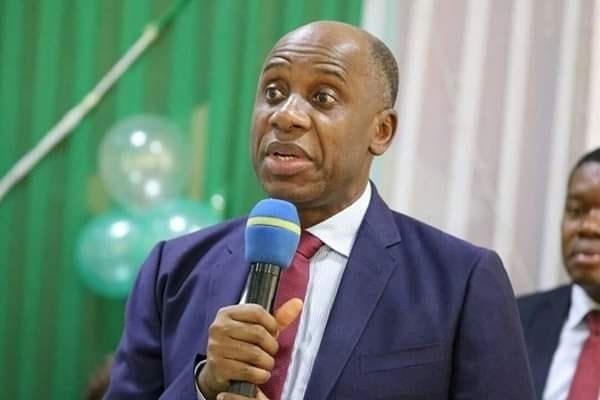
The simmering political rivalry between former Rivers State Governor Rotimi Amaechi and current Minister of the Federal Capital Territory (FCT), Nyesom Wike, has taken a new dramatic turn on June 4, 2025.
In a recent interview on June 4, Amaechi delivered a pointed and dismissive response to Wike’s latest provocations, declaring that he would not “join issues with children.”
This statement, layered with sharp undertones, has reignited debates about political maturity, leadership, and influence in Rivers State and beyond.
The feud between Amaechi and Wike is one of Nigeria’s most high-profile political rivalries.
Both men have held significant political offices Amaechi as Governor of Rivers State and Minister of Transportation, and Wike as Governor and now FCT Minister.
Their contest for dominance in Rivers politics has often spilled into the public arena.
This statement was interpreted by Wike as a critique on power and greed within Rivers State politics, intensifying the public exchange between the two influential figures.
Wike dismissed this as a hunger for political relevance rather than material need, mocking Amaechi’s standing in the political landscape.
Amaechi’s response was both direct and laced with sarcasm.
He rejected Wike’s claim that Wike “made” him governor, asserting instead that his rise was due to divine providence, former Governor Peter Odili’s influence, and the Nigerian judiciary’s support.
“Nobody made me governor. God, Peter Odili, and the Nigerian judiciary made me governor.
Nobody,” Amaechi emphasized, questioning why no one had ever asked Wike to explain how he supposedly “made” him governor.
The former governor also revisited his past working relationship with Wike.
Revealing that he appointed Wike as his Chief of Staff not out of favor but as a strategic move to keep him under close watch.
“Mohammed Adoke flew all the way from Abuja to Port Harcourt.
That week he asked me to make him commissioner for finance and I said no, he has to work under me.
I want him as chief of staff so I can supervise him,” Amaechi disclosed.
He further mocked Wike’s self-aggrandizement, sarcastically noting, “You know, he made himself chief of staff.
He made himself governor, made himself minister. and also made himself local government chairman.”
At the heart of this exchange lies a deeper power struggle that has shaped Rivers State politics for over a decade.
Both Amaechi and Wike have loyal followings and wield significant influence, but their rivalry frequently involves personal attacks and political maneuvering.
Amaechi’s refusal to engage in a “war of words” with what he terms “children” critiques Wike’s political discourse approach as immature and lacking decorum.
This framing appeals to a broader audience concerned with the tone and quality of political debate in Nigeria.
Amaechi Challenges Opponent’s Credibility Approach
This public spat invites reflection on the nature of political leadership and rivalry in Nigeria.
The Amaechi-Wike feud exemplifies how personal ambitions and grudges can dominate political narratives, sometimes overshadowing policy and governance issues.
Amaechi’s emphasis on mentorship, supervision, and strategic appointments points to a leadership style focused on control and oversight.
While his critique of Wike’s self-promotion highlights concerns about ego and political entitlement.
The controversy has elicited mixed reactions from political observers and the public.
Supporters praise Amaechi’s composure and refusal to engage in petty squabbles, viewing it as political maturity.
Conversely, Wike’s supporters argue that his rise is a testament to his political acumen and grassroots appeal.
Media analysts suggest this exchange will further polarize Rivers State’s political landscape, influencing elections and party dynamics significantly.
Rotimi Amaechi’s recent interview and sharp retort to Nyesom Wike’s provocations highlight the intense political rivalry defining Rivers State politics.
By refusing to engage in a direct confrontation and instead framing the dispute as a matter of political maturity.
Amaechi has set a tone that challenges his opponent’s credibility and approach.
Political Legitimacy
This episode is more than just a clash of personalities; it reflects broader themes of leadership style.
Political legitimacy, and the role of personal ambition in shaping Nigeria’s political discourse.
As the drama unfolds, stakeholders and citizens alike will be watching closely.
Aware that this rivalry’s outcome could have lasting implications for governance and political stability in Rivers State and beyond.
The question remains: can Nigeria’s political leaders rise above personal vendettas to focus on substantive issues affecting their constituents?
Or will such bitter rivalries continue to dominate the political landscape.
Amaechi’s refusal to “join issues with children” calls for greater statesmanship in a political arena often marred by acrimony.

1 Comment
Pingback: ‘I Disagree’ – Rotimi Amaechi Rejects Atiku’s ADC Candidate Pick - wahalaupdate