


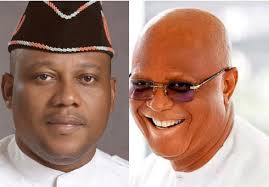
Akwa Ibom State’s political landscape was shaken to its core on June 6, 2025, as a high-profile resignation exposed deep fissures within Governor Umo Eno’s administration.
Following his controversial defection from the Peoples Democratic Party (PDP) to the All Progressives Congress (APC).
Dr. Ini Ememobong, the Commissioner for Special Duties and Ibom Deep Sea Port, boldly rejected the governor’s political volte-face, resigning in protest and refusing to abandon his party and principles on June 6.
Governor Eno orchestrated his defection with fanfare at the Government House in Uyo, where he publicly severed ties with the PDP.
Aligned With The APC, Praised By Party Heavyweights
Aligning himself with the APC in a move hailed by APC heavyweights including Lagos Governor Babajide Sanwo-Olu and Senate President’s wife, Mrs. Ekaette Unoma Akpabio.
Eno’s directive was unequivocal: all political appointees unwilling to follow him into the APC must resign immediately.
This ultimatum was met with swift compliance except from Ememobong, who chose conscience over convenience.
Ememobong’s resignation letter, circulated widely on social media, was a scathing indictment of the governor’s defection.
He Declared His Inability To Join The APC
Based on my personal conviction” and tendered his resignation as commissioner and member of the State Executive Council.
His principled stand was framed as a rejection not just of Eno’s decision.
But of the APC’s ideology and conduct, which he described as fundamentally opposed to his long-held political beliefs.
The commissioner’s refusal to toe the line has ignited fierce controversy.
While Eno’s camp insists the defection signifies a “position of strength” and a strategic alignment with President Bola Ahmed Tinubu’s economic reforms.
Ememobong’s departure exposes a simmering resentment and ideological discord within the state’s political elite.
His resignation is the first high-profile cabinet exit since the defection.
Signaling that loyalty to party principles still commands allegiance over political expediency in Akwa Ibom.
Social Media Erupted With Polarized Reactions
Supporters of Ememobong praised his courage to stand by his convictions in the face of political pressure, framing him as a beacon of integrity in a climate of opportunism.
Critics accused him of disloyalty and undermining the governor’s mandate.
Suggesting that his resignation could destabilize the state’s governance and disrupt the ambitious Ibom Deep Sea Port project under his watch.
Political analysts have interpreted the resignation as a harbinger of deeper political realignments ahead of the 2027 elections.
Ememobong’s refusal to follow suit challenges the narrative of a seamless transition and exposes fault lines that could fracture the ruling coalition in Akwa Ibom.
Despite the political storm, Ememobong emphasized that his resignation was not borne out of personal animosity toward Governor Eno.
He described him as a “brother” and a leader who entrusted him with critical responsibilities.
He expressed gratitude to both Eno and his predecessor, Udom Emmanuel, for the opportunities afforded to him.
Governor Eno underscored that he grounded his decision purely in political principle rather than personal conflict.
This Dramatic Episode Has Thrust Akwa Ibom To National Spotlight
Raising uncomfortable questions about the nature of political loyalty.
The ethics of party switching, and the future of governance in the state.
The governor demands absolute allegiance or resignation, but critics label his hardline stance autocratic and divisive.
Potentially alienating key stakeholders and undermining democratic inclusiveness.
This marks principled resistance, ideological clashes, and a loyalty test that could reshape Akwa Ibom’s politics.
The unfolding controversy underscores the volatile nature of Nigerian politics.
The party allegiance is often fluid but sometimes fiercely contested.
And where individual conscience can provoke seismic shifts in power dynamics.
