


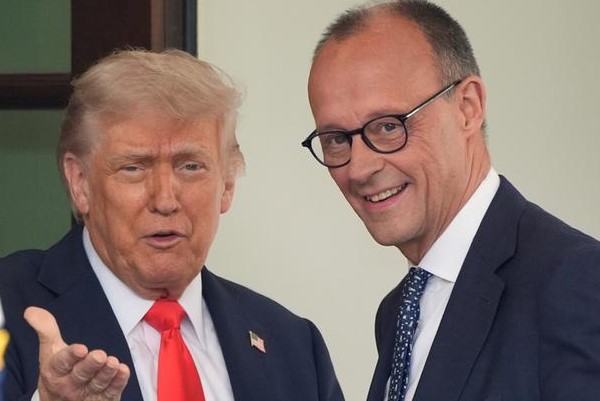
The United States President, Donald Trump, has on Tuesday March 2, 2026 hosted the German Chancellor, Friedrich Merz, at the White House in what marked his first meeting with a foreign leader since Washington joined Israel in military strikes against Iran.
According to reports, the meeting, long scheduled to address the war in Ukraine and strained European Union-United States trade relations, was dramatically overtaken by the escalating conflict in the Middle East.
Trump’s Iran Airstrikes Signal Weeks-Long Shift in Global Diplomacy
Trump’s airstrikes signal on Iran lasting weeks shifts global diplomacy dramatically.
Tehran hits back at US bases and allies fiercely across the volatile region now.
World leaders scramble as tensions escalate between superpowers and Middle East foes alike.
Markets tumble while alliances strain under the weight of prolonged conflict threats.
Diplomatic channels reopen urgently, seeking ceasefires amid fears of wider war spreading.
Trump’s bold stance reshapes alliances, forcing rivals to recalibrate strategies swiftly.
Merz who is a vocal critic of Iran’s leadership, said Germany shared in what he described as the Iranian people’s “relief” that the “mullah regime is coming to an end.”
However, he refrained from criticising Washington and Tel Aviv over the legality of the strikes aimed at dismantling Tehran’s nuclear and missile capabilities.
Berlin, alongside Paris and London, has stated that it would only support its Gulf allies with “defensive action” against Iran.
A stance that reportedly drew criticism from US officials who described Europe’s response to “Operation Epic Fury” as “soft.”
Merz’s Delicate Bind: Balancing Solidarity Amid Strikes and Tensions
Merz faces a delicate bind from these strikes, balancing firm solidarity with Western allies amid rising tensions.
European caution grows over deeper military entanglements now unfolding rapidly.
He navigates pressure from Berlin’s public wary of war escalation while honoring NATO commitments to the US.
Domestic politics demand restraint as global risks intensify daily.
Strategic talks intensify with EU partners seeking de-escalation paths without abandoning Israel or America fully.
Merz’s stance tests leadership in this precarious transatlantic tightrope walk.
Meanwhile, French President Emmanuel Macron reveals eight European countries join France’s initiative to extend its nuclear deterrence umbrella across the continent.
Germany being a “key partner in this effort,” signalling a shift toward stronger European-led security guarantees amid growing geopolitical uncertainty.
Merz’s proposal highlights surging European demands for strategic autonomy amid fraying transatlantic bonds under strike pressures.
Nations Rethink Reliance on US-Led Security Guarantees Amid Crisis
The Nations rethink reliance on US-led security guarantees now.
Paris and others amplify voices for independent defense capabilities, decoupling from Washington’s erratic Middle East military adventures boldly.
EU unity strengthens around self-reliant postures firmly.
Fresh strains test NATO’s cohesion as Europe eyes sovereign arms, budgets, and rapid response forces independently.
Autonomy push accelerates in this pivotal geopolitical shift swiftly.
Despite some political ideological and stylistic differences, Merz and Trump have maintained cordial ties.
Merz, 70, multilateral Christian Democrat, contrasts Trump’s 79-year-old blunt, unconventional property magnate diplomacy sharply.
Germany has since unveiled substantial increases in military investment.
Merz at Munich: Acknowledges Allies’ Rift, Urges Transatlantic Trust Revival
At the Munich Security Conference in February, Merz acknowledged a “deep rift” between traditional allies and urged Washington to “repair and revive transatlantic trust together.”
During their first White House meeting last June, Merz had urged Trump to intensify pressure on Moscow to end what he described as the “terrible” war in Ukraine.
In response, Trump described Merz as “a very good man to deal with,” joking that he could be “difficult”, a remark widely interpreted as praise rather than criticism.
Merz builds personal rapport with Trump, gifting his grandfather’s German birth certificate to honor shared ancestry warmly.
Merz’s Heritage Gift Bridges Cultural Gaps in Tense Diplomacy
This gesture bridges cultural gaps amid tense diplomacy.
He extends a heartfelt invitation for Trump to visit ancestral homeland, fostering goodwill beyond policy clashes now.
Personal ties aim to soften hardline stances effectively.
Rapport strengthens amid global uncertainties unfolding rapidly.
Trade Tensions Linger
Beyond the Iran and Isreal conflict, economic friction remains high on the agenda.
On Trump’s sweeping tariff policies, Merz is expected to present what aides describe as the EU’s “coordinated position.”
A spokesperson said, “Businesses need planning security, and that applies on both sides of the Atlantic.”
Germany’s influential Mechanical Engineering lobby group urged Merz to leverage his relationship with Trump, “despite the current focus on the Iran war,” to secure “a comprehensive and reliable tariff agreement between the EU and the USA.”

1 Comment
Pingback: A Symbolic Artwork at the Crossroads of Power, Politics, Diplomacy - wahalaupdate